





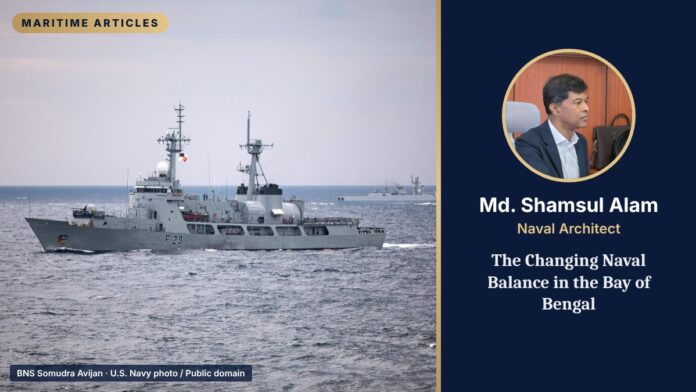

As major naval powers invest in advanced surface combatants, submarines, intelligent naval platforms and autonomous maritime systems, Bangladesh must reassess its long-term naval development strategy in the context of the rapidly changing maritime capabilities of its neighbouring countries.


1. A New Era of Global Naval Warfare
For approximately three decades following the end of the Cold War, many naval forces prioritized relatively compact, multi-role frigates and offshore patrol vessels designed for maritime security, anti-piracy operations, protection of commercial shipping and limited expeditionary operations.
Today, that philosophy is undergoing a fundamental transformation.
The emergence of advanced missile technologies, unmanned maritime systems, artificial intelligence, sophisticated electronic warfare capabilities and renewed great-power competition is reshaping global naval procurement and warship design.
Japan’s Aegis System Equipped Vessels (ASEVs), South Korea’s next-generation KDDX destroyers, Italy’s DDX programme and France’s futuristic surface combatant concepts reflect this changing direction.
Modern warships are increasingly being developed as sophisticated, interconnected maritime platforms with extensive electrical power generation, advanced sensors, digital architecture and provisions for autonomous systems.
This transformation carries significant implications for Bangladesh, particularly considering the naval modernization programmes of India, Myanmar and other regional powers operating across the Indian Ocean and Bay of Bengal.
2. India: From a Regional Navy to a Major Blue-Water Naval Power
India, Bangladesh’s largest neighbour, is undertaking an extensive naval modernization programme aimed at strengthening its presence throughout the Indian Ocean and wider Indo-Pacific region.
The Indian Navy is gradually transforming itself from a predominantly regional maritime force into a major blue-water navy supported by a sophisticated domestic shipbuilding and defence technology industry.
| Programme | Approximate displacement | Category |
|---|---|---|
| Vikrant-class | 45,000 tonnes | Aircraft carrier |
| Project 15B | 7,400 tonnes | Guided-missile destroyer |
| Project 15A | 7,400 tonnes | Guided-missile destroyer |
| Project 17A | 6,670 tonnes | Multi-role stealth frigate |
| Project 17 | 6,200 tonnes | Multi-role frigate |
| Project 18A | 14,000–15,000 tonnes | Reported future large combatant concept |
India completed the induction of four Project 15B destroyers with the commissioning of INS Surat in January 2025. Its Project 17A frigate programme has also progressed significantly, with the sixth vessel, Mahendragiri, delivered to the Indian Navy on 30 April 2026.
According to reports published in July 2026, India is also considering three major future surface combatant programmes: Project 15C destroyers, Project 17B frigates and Project 18A large surface combatants.
The reported Project 18A displacement of approximately 14,000–15,000 tonnes places it within the emerging international trend towards heavyweight surface combatants. However, the programme remains at a preliminary planning stage rather than confirmed construction.
India’s greatest advantage: Indigenous shipbuilding
The most significant aspect of India’s naval development is not simply the size of its fleet but its increasing technological and industrial self-reliance.
Government-owned and private-sector shipyards participate in India’s naval and coast guard construction programmes. These include Mazagon Dock Shipbuilders, Garden Reach Shipbuilders & Engineers, Cochin Shipyard, Goa Shipyard, Hindustan Shipyard, Larsen & Toubro and other industrial enterprises.
India has also developed institutional warship design capabilities through its Warship Design Bureau, supported by domestic research, engineering and manufacturing organizations.
According to an Indian government publication issued in December 2025, 51 large naval ships were under construction domestically, representing an investment of approximately INR 90,000 crore.
For Bangladesh, India’s industrial development provides an important lesson: long-term naval capability cannot be achieved sustainably through foreign procurement alone.
3. Myanmar: An Emerging Naval Capability on Bangladesh’s Eastern Maritime Frontier
While considerable attention is generally directed towards India’s naval modernization, developments in Myanmar deserve equally serious examination.
Despite prolonged internal conflict, political instability, international sanctions and economic difficulties, Myanmar has continued investing in indigenous naval construction, submarines and maritime infrastructure.
Myanmar’s indigenous frigate development
On 8 March 2026, Myanmar commissioned UMS Thalun Min, the largest warship domestically constructed in the country’s naval shipbuilding history.
The vessel represents a significant advancement over Myanmar’s previous indigenous frigate programmes.
| Parameter | UMS Thalun Min |
|---|---|
| Length overall | 135 m |
| Beam | 14.5 m |
| Draught | 4.1 m |
| Displacement | Approximately 3,500 tonnes |
| Reported maximum speed | 30 knots |
| Construction | Myanmar |
| Commissioning | March 2026 |
Myanmar had previously constructed the Aung Zeya-class and Kyan Sittha-class frigates, demonstrating a progressive increase in indigenous shipbuilding capability.
Indicative displacement; vessel size alone does not determine capability.
Myanmar’s submarine capability and shipbuilding infrastructure
Myanmar has acquired submarines of both Russian and Chinese origin, establishing an underwater naval capability alongside its expanding surface fleet.
Another significant development occurred in March 2026, when Myanmar inaugurated a 40,000-tonne dry dock facility intended to accommodate naval construction, repair and commercial shipbuilding activities.
The facility represents an investment not only in fleet expansion but also in long-term maintenance and industrial independence.
Nevertheless, Myanmar’s actual operational readiness, fleet availability and ability to sustain sophisticated naval systems remain difficult to independently assess, particularly given its ongoing internal conflict.
For Bangladesh, the important observation is that even a neighbouring country facing significant economic and political difficulties has continued developing domestic frigate construction capabilities.
4. Bangladesh Navy: Progress, Present Position and Future Challenges
Bangladesh Navy has made substantial progress since independence, evolving from a small coastal force into a three-dimensional navy with surface, submarine and naval aviation capabilities.
The induction of two submarines in 2017, modern corvettes, frigates, maritime patrol aircraft and naval helicopters represents significant progress in the country’s maritime defence development.
The construction of patrol craft at Khulna Shipyard has also established a foundation for indigenous naval shipbuilding.
However, when compared with the development trajectories of India and Myanmar, Bangladesh faces an important strategic and industrial question.
While India has progressed towards indigenous aircraft carriers, advanced destroyers and submarines, and Myanmar has commissioned domestically constructed frigates of approximately 3,500 tonnes, Bangladesh’s demonstrated indigenous naval construction experience remains concentrated primarily on patrol craft and auxiliary vessels.
This does not imply that Bangladesh lacks the industrial or professional potential to progress further. Rather, it highlights the importance of establishing a coordinated, long-term national naval shipbuilding strategy.
5. Comparative Analysis of Regional Naval Capabilities
| Area of comparison | India | Myanmar | Bangladesh |
|---|---|---|---|
| Naval orientation | Blue-water navy | Regional and coastal navy | Regional and coastal navy |
| Aircraft carriers | Operational | None | None |
| Destroyers | Operational | None | None |
| Frigates | Indigenous and imported | Indigenous and imported | Primarily imported |
| Corvettes | Indigenous and imported | Indigenous and imported | Primarily imported |
| Submarines | Nuclear and conventional | Conventional | Conventional |
| Naval aviation | Extensive | Limited | Established |
| Indigenous frigate construction | Established | Demonstrated | Not yet demonstrated |
| Indigenous destroyer construction | Established | Not demonstrated | Not demonstrated |
| Domestic naval design capability | Advanced | Developing | Developing |
| Naval industrial ecosystem | Extensive | Expanding | Developing |
| Foreign technology dependence | Gradually decreasing | Significant | Significant |
This comparison represents publicly documented capabilities and industrial development, not an assessment of classified combat readiness or operational superiority.
The comparative analysis indicates that the most significant difference is not necessarily the number of naval vessels each country operates, but the degree of technological independence and indigenous industrial maturity.
Indicative displacement; vessel size alone does not determine capability.
6. The Influence of China and Other Regional Powers
Although China does not share a direct maritime boundary with Bangladesh, its growing naval presence in the Indian Ocean constitutes an important element of the regional maritime security environment.
China’s development of aircraft carriers, Type 055 large surface combatants, modern frigates, submarines and overseas logistical facilities reflects its expanding international maritime ambitions.
China is also a major supplier of naval platforms and equipment to several South Asian countries, including Bangladesh, Myanmar and Pakistan.
Pakistan’s acquisition of modern frigates and its submarine modernization programmes further illustrate the broader technological transformation taking place across the northern Indian Ocean.
Although Pakistan is not an immediate maritime neighbour of Bangladesh, its naval modernization provides another relevant example of international technology partnerships and domestic shipbuilding development.
The increasing interaction of Indian, Chinese, American, European and other naval forces in the Indian Ocean creates both opportunities and challenges for Bangladesh.
Bangladesh must maintain constructive diplomatic relationships with all major maritime powers while preserving its independent national interests, procurement autonomy and freedom of strategic decision-making.
7. Why the Bay of Bengal Is Becoming Increasingly Important
The Bay of Bengal is no longer merely a geographical extension of the Indian Ocean. It is an increasingly important maritime region connecting South Asia, Southeast Asia and international shipping routes.
For Bangladesh, maritime security is directly linked to national economic security.
The country’s dependence on imported energy, industrial raw materials, international container trade, maritime fisheries and offshore resources makes uninterrupted maritime operations essential.
The development and expansion of Chattogram Port, Matarbari Deep Sea Port, Bay Terminal, Mongla Port, Payra Port and offshore energy infrastructure will further increase the economic importance of Bangladesh’s maritime domain.
Bangladesh’s maritime jurisdiction encompasses approximately 118,813 square kilometres following the settlement of maritime boundary disputes with Myanmar in 2012 and India in 2014.
Protecting maritime rights, commercial shipping, fisheries, offshore installations and critical infrastructure therefore requires coordination among Bangladesh Navy, Bangladesh Coast Guard, port authorities and other maritime institutions.
The objective should be to maintain a secure, stable and peaceful maritime environment rather than participate in an unsustainable regional arms race.
8. Should Bangladesh Follow the Global Trend Towards Bigger Warships?
The global return of heavyweight warships raises an important question: should Bangladesh also pursue increasingly large naval platforms?
From a naval architecture and economic perspective, bigger does not automatically mean better.
Japan, Italy, France, South Korea and India have different strategic responsibilities, financial resources, industrial capabilities and geographical operating environments.
Bangladesh must develop a navy appropriate to its own national circumstances.
Future fleet decisions should therefore be based on comprehensive feasibility studies addressing operational requirements, acquisition costs, lifecycle expenditure, maintenance infrastructure, personnel requirements and technological sustainability.
A sophisticated vessel that cannot be maintained economically or remains unavailable for prolonged periods may deliver less practical value than a smaller, reliable and consistently operational platform.
Bangladesh should pursue credible naval capability rather than numerical or displacement-based competition with its neighbours.
9. Indigenous Naval Shipbuilding: Where Bangladesh Must Accelerate
The most important lesson Bangladesh can learn from India, Myanmar and other established naval shipbuilding nations is the strategic importance of indigenous naval shipbuilding. However, achieving meaningful progress in this sector requires a fundamental reconsideration of Bangladesh’s existing naval shipbuilding philosophy.
Limitations of existing Navy-operated shipyards
Bangladesh Navy’s indigenous newbuilding activities have historically relied heavily on two Navy-operated shipyards: Khulna Shipyard Limited (KSY), experienced in constructing patrol vessels, landing craft, tugboats, auxiliary vessels and other specialized craft; and Dockyard and Engineering Works Limited (DEWL), experienced in constructing patrol craft, gunboats, landing craft, ferries and various specialized vessels.
Both shipyards have made commendable contributions to Bangladesh’s naval and maritime development. Their achievements should be recognized as an important foundation for the country’s indigenous naval construction capability.
However, their geographical locations along inland waterways, navigational draught restrictions, launching arrangements and existing production infrastructure may impose significant limitations on the construction and delivery of larger naval vessels.
The construction of larger frigates and other sophisticated naval platforms requires suitable waterfront access, adequate navigational depth, extensive fabrication facilities, heavy lifting arrangements, specialized outfitting infrastructure, testing facilities and highly experienced industrial management.
Expanding naval construction capacity exclusively through these two shipyards may require substantial public investment, while suitable infrastructure and professional expertise may already exist elsewhere within the national shipbuilding industry.
Bangladesh should therefore assess its entire national shipbuilding capacity rather than restrict its industrial development ambitions to a limited number of Navy-operated facilities.
The importance of professional shipyard management
Another important institutional issue is the management structure of Navy-operated shipyards.
The management of a modern shipbuilding enterprise is a highly specialized industrial and commercial discipline. It requires extensive knowledge of naval architecture, marine engineering, production engineering, project management, procurement, financial management, quality assurance and industrial workforce development.
Serving naval officers possess valuable operational experience, leadership capabilities and knowledge of naval requirements. However, naval operational command and industrial shipyard management are distinct professional disciplines.
Frequent rotation of serving officers through industrial management positions may also create challenges in maintaining long-term leadership continuity, specialized industrial experience and institutional knowledge.
Internationally, many leading naval shipbuilding enterprises operate under professional corporate management, employing experienced naval architects, engineers, industrial managers and financial professionals.
Naval authorities generally play a central role in establishing operational requirements, overseeing contractual and technical compliance, ensuring national security and accepting completed vessels.
Bangladesh should consider adopting a more balanced management model that combines naval operational expertise with permanent professional industrial management.
This would not diminish the Navy’s authority or involvement. Rather, it could strengthen industrial productivity, accountability, engineering competence and long-term organizational sustainability.
| Country | Major organizations | Industrial model |
|---|---|---|
| United States | Huntington Ingalls, General Dynamics | Private enterprises |
| United Kingdom | BAE Systems, Babcock | Private enterprises |
| France | Naval Group | State-controlled corporate |
| Italy | Fincantieri | State-controlled, listed |
| Germany | TKMS, NVL | Commercial corporate |
| Japan | Mitsubishi Heavy Industries, Japan Marine United | Private enterprises |
| South Korea | HD Hyundai Heavy Industries, Hanwha Ocean | Private enterprises |
| India | MDL, GRSE, CSL, GSL, L&T | Mixed public-private |
These international examples demonstrate that sophisticated and sensitive naval vessels can be constructed by professionally managed industrial enterprises, including private-sector shipyards, while maintaining stringent national security and defence requirements. Government ownership is not, by itself, a prerequisite for successful naval shipbuilding.
10. Unlocking the Potential of Bangladesh’s Private Shipbuilding Industry
Bangladesh has already demonstrated considerable potential in commercial shipbuilding and the construction of internationally classed vessels for domestic and overseas markets.
Several private shipyards have experience in constructing ocean-going vessels, specialized marine platforms, offshore support vessels, dredgers, cargo ships, tankers and other commercial vessels.
Private shipbuilding enterprises such as Western Marine Shipyard, Ananda Shipyard, Khan Brothers Shipbuilding, Karnafuly Shipyard, Radiant Shipyard, FMC Dockyard, Meghna Shipbuilders and other industrial organizations represent an important national industrial resource.
Several private shipyards have experience working under internationally recognized classification societies such as Bureau Veritas, Lloyd’s Register, DNV and ABS.
Although commercial shipbuilding experience does not automatically qualify a shipyard for sophisticated naval construction, it provides an important foundation upon which specialized naval engineering and production capabilities can be developed.
Bangladesh Navy should actively encourage qualified private shipyards and dockyards to participate in naval shipbuilding programmes, subject to appropriate technical, financial, infrastructure, quality assurance and national security assessments.
Rather than requiring every shipyard to independently possess all necessary capabilities, Bangladesh should encourage joint ventures, consortiums, strategic partnerships and subcontracting arrangements between government-owned and private shipyards.
Such collaboration would enable the country to combine existing infrastructure, professional expertise, financial resources, production capacity and specialized engineering knowledge.
The eligibility of a shipyard for naval construction should be determined by its infrastructure, technical competence, relevant experience, financial strength, quality assurance systems and ability to comply with national security requirements, not merely by its ownership status.
Private shipyards should not be viewed as competitors to government-owned shipyards. Instead, both should be recognized as complementary national industrial resources.
An inclusive shipbuilding approach would facilitate greater competition, reduce unnecessary duplication of infrastructure, create skilled employment, encourage innovation and strengthen the country’s industrial supply chain.
The development of Bangladesh’s naval shipbuilding industry should be regarded as a national industrial responsibility rather than the exclusive responsibility of a few government-owned shipyards.
11. The Importance of Indigenous Naval Design and Research
One of the most significant institutional lessons Bangladesh can learn from India is the importance of maintaining dedicated national warship design expertise.
Bangladesh possesses a considerable pool of qualified naval architects, marine engineers and other engineering professionals working both domestically and internationally. However, their collective expertise has not yet been fully integrated into a coordinated national naval engineering and shipbuilding framework.
Bangladesh should consider establishing or strengthening a National Warship Design and Maritime Technology Bureau, bringing together relevant expertise from Bangladesh Navy, government and private shipyards, independent engineering organizations, universities and research institutions.
Such an institution could support naval architecture research, hydrodynamic investigations, structural engineering, digital ship design, engineering standardization, feasibility studies, lifecycle assessment and independent technical evaluation.
It could also facilitate collaboration with internationally recognized naval design organizations and support the retention of institutional engineering knowledge across successive shipbuilding programmes.
Indigenous naval shipbuilding should not remain limited to the fabrication and assembly of foreign-designed vessels.
International collaboration should progressively enable Bangladeshi engineers and industrial organizations to acquire greater design knowledge, technical documentation, engineering competence and long-term maintenance capability.
The ultimate objective should be greater national ownership of engineering knowledge and the ability to support naval vessels throughout their operational lives.
12. Recommendations for the Future Development of Bangladesh Navy
Considering international naval shipbuilding practices, regional developments and Bangladesh’s existing industrial potential, the following recommendations deserve serious consideration.
12.1. Adopt an inclusive national naval shipbuilding policy
Bangladesh Navy should promote a comprehensive naval shipbuilding policy that recognizes government-owned and private shipyards as strategic partners in national maritime defence and industrial development. The policy should encourage effective utilization of the country’s entire shipbuilding infrastructure rather than concentrating indigenous naval construction opportunities within a limited number of government-owned facilities.
12.2. Prioritize public-private shipbuilding collaboration
Government-owned shipyards and qualified private shipyards should be encouraged to undertake naval construction projects through joint ventures, consortiums, strategic partnerships and subcontracting arrangements. Where government-owned shipyards face limitations relating to infrastructure, geographical location, navigational draught or production capacity, suitable private shipyards should be considered as industrial partners. Such collaboration could enable Bangladesh to undertake larger and more sophisticated naval shipbuilding projects without necessarily requiring extensive duplication of existing industrial infrastructure.
12.3. Introduce professional industrial management in government-owned shipyards
Government-owned shipyards should consider adopting professionally managed corporate structures supported by experienced naval architects, marine engineers, production specialists, financial professionals and industrial management experts. Serving naval officers should continue to contribute their operational expertise, strategic guidance and technical oversight, while permanent professional industrial management should ensure continuity, productivity, commercial efficiency and institutional knowledge retention. Appointments to senior industrial management positions should give appropriate consideration to relevant professional qualifications, shipbuilding experience and demonstrated management competence.
12.4. Ensure competitive and ownership-neutral naval procurement
Naval procurement policies should provide opportunities to all technically and financially qualified shipyards, irrespective of their ownership status. Unnecessarily restrictive eligibility conditions that exclude competent private shipyards may reduce competition, discourage industrial investment and limit opportunities for innovation. Tender evaluation should emphasize relevant construction experience, infrastructure, financial capability, professional manpower, quality assurance, technical compliance and national security requirements. Participation by qualified public-private joint ventures should also be encouraged where such arrangements offer demonstrable national benefits.
12.5. Utilize existing national shipbuilding infrastructure
Before investing substantial public funds in establishing or expanding government-owned shipbuilding infrastructure, Bangladesh should undertake a comprehensive assessment of existing public and private shipyard facilities. Where suitable infrastructure is already available within the private sector, strategic industrial partnerships may provide a more economically sustainable alternative. The country should avoid unnecessary duplication of capital-intensive facilities and instead encourage coordinated utilization of existing national industrial assets.
12.6. Strengthen independent naval design and engineering capabilities
Bangladesh Navy should actively engage domestic naval architecture and marine engineering organizations, universities, research institutions and qualified independent professionals in feasibility studies, ship design, technical evaluation, project management and construction supervision. Independent professional participation could strengthen engineering accountability, improve technical decision-making and contribute to the development of national naval design competence.
12.7. Ensure meaningful technology transfer
International naval procurement and shipbuilding contracts should incorporate meaningful provisions for technology transfer, professional training, domestic engineering participation, technical documentation and long-term maintenance support. Technology transfer should produce measurable industrial and professional benefits rather than remain limited to contractual commitments or basic assembly activities. Foreign collaboration should ultimately contribute to greater national technological independence.
12.8. Develop a comprehensive national naval industrial ecosystem
Bangladesh should encourage the development of an integrated naval industrial ecosystem comprising government and private shipyards, independent design organizations, equipment manufacturers, ship repair facilities, universities, research institutions, classification societies and international technology partners. A sustainable naval industry cannot be established through shipyards alone. It requires a supporting network of engineering organizations, skilled professionals, industrial suppliers and specialized service providers.
12.9. Prioritize lifecycle sustainability and operational availability
Future naval procurement should emphasize operational availability, lifecycle expenditure, maintainability, domestic technical support and spare parts availability rather than initial acquisition cost alone. Comprehensive technical and economic feasibility studies should be undertaken before major procurement decisions. The ability to maintain and support vessels domestically should receive significant consideration during platform and supplier selection.
12.10. Strengthen domestic ship repair and maintenance capabilities
Bangladesh should encourage greater participation by qualified public and private dockyards in naval vessel repair, maintenance, refitting and modernization. Domestic maintenance capabilities would help reduce dependence on overseas facilities, minimize vessel downtime, conserve foreign currency and develop specialized industrial expertise. Appropriate security arrangements and technical qualification procedures could enable competent private dockyards to support selected naval maintenance activities.
12.11. Invest in human resource development and emerging technologies
Continuous professional development of naval personnel, naval architects, marine engineers, researchers and industrial professionals is essential for sustainable naval modernization. Greater collaboration among Bangladesh Navy, engineering universities, domestic industries and international research organizations should be encouraged. Particular attention should be given to digital ship design, advanced manufacturing, energy efficiency, intelligent machinery management, predictive maintenance and emerging maritime technologies.
12.12. Treat naval procurement as an instrument of national industrial development
Every major naval procurement programme should contribute not only to the modernization of Bangladesh Navy but also to the development of domestic engineering capabilities, industrial infrastructure, skilled employment and technological advancement. Naval expenditure should be viewed not merely as defence expenditure but also as an opportunity to strengthen the country’s industrial and technological foundations. Bangladesh Navy could become a major catalyst for the development of the entire national shipbuilding industry by creating opportunities for qualified domestic industrial and engineering organizations.
13. Expected National Benefits of Public–Private Naval Shipbuilding Collaboration
A well-structured public-private collaboration model could generate significant economic and technological benefits beyond the immediate requirements of Bangladesh Navy.
It could strengthen Bangladesh’s commercial shipbuilding industry, enhance international competitiveness, create opportunities for marine equipment manufacturing and encourage investment in advanced engineering infrastructure.
Furthermore, a sustainable domestic naval shipbuilding programme could help retain qualified naval architects, marine engineers and technical professionals within the country while creating opportunities for Bangladeshi professionals working abroad to contribute their expertise.
Conclusion: A Strong Navy Requires a Strong National Shipbuilding Industry
The global naval environment is undergoing a fundamental transformation. Major naval powers are investing in increasingly sophisticated warships, while Bangladesh’s immediate neighbours are strengthening both their naval fleets and indigenous shipbuilding industries.
India has established itself as a major indigenous naval shipbuilding nation through sustained investment in engineering, research, government-owned shipyards and private industrial enterprises.
Myanmar, despite considerable economic and institutional difficulties, has demonstrated its ability to construct increasingly sophisticated frigates domestically.
Bangladesh Navy has made commendable progress in fleet modernization, personnel development and indigenous patrol vessel construction. Nevertheless, the next stage of development requires a broader national industrial vision.
Bangladesh need not compete with India in fleet size or imitate the procurement strategies of major global powers. Nor should the naval modernization of neighbouring countries automatically be interpreted as hostile intent.
However, Bangladesh cannot afford to overlook the technological and industrial developments taking place around it.
The country’s future naval shipbuilding capability should not remain constrained by the infrastructure, geographical limitations or management structures of a limited number of Navy-operated shipyards.
Bangladesh already possesses government-owned shipyards, private shipbuilding enterprises, independent naval architecture and engineering organizations, qualified professionals and an established maritime industrial sector.
These resources must be brought together through effective institutional collaboration, competitive procurement, professional industrial management and meaningful international technology partnerships.
Government-owned and private shipyards should complement each other rather than operate as isolated or competing industrial entities. Bangladesh Navy should actively encourage this collaboration and create an enabling environment in which technically competent domestic organizations can contribute to national naval development.
A strong navy cannot be built solely through the importation of warships, nor can a strong naval shipbuilding industry be developed by relying exclusively on government-owned shipyards.
Bangladesh Navy should become a catalyst for the development of the country’s entire naval shipbuilding industry.
The ultimate ambition should be to transform Bangladesh from a predominantly naval platform-importing nation into an increasingly capable naval designing, shipbuilding and maritime technology nation.
Such development would contribute not only to national maritime security but also to industrial growth, skilled employment, technological advancement, foreign currency savings and the overall economic development of Bangladesh.
References and background materials
Indian Ministry of Defence and Press Information Bureau; Indian Navy Warship Design Bureau; Naval News; Myanmar government publications; Bangladesh Navy; Khulna Shipyard Limited and Dockyard and Engineering Works Limited; Larsen & Toubro, BAE Systems, Fincantieri, Naval Group and HD Hyundai Heavy Industries; Bangladesh’s public and private shipbuilding industry.
Disclaimer: All views, analysis and information in this article are solely the author’s own. Maritime News BD bears no responsibility for them.