





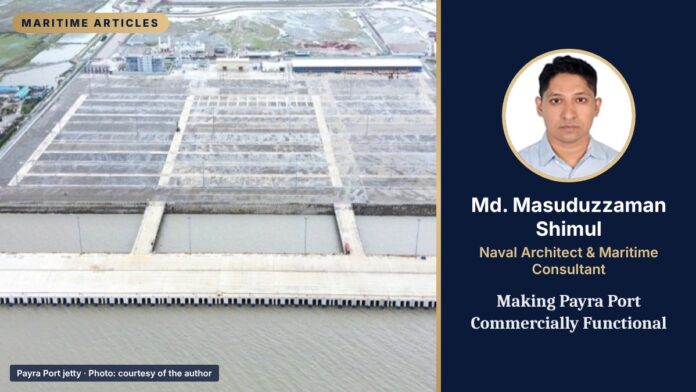

Bangladesh’s third seaport needs more than new infrastructure. It needs dependable navigation, competitive logistics and a cargo base that can sustain its operations.


A port can have a modern jetty, cranes and extensive land, yet remain unattractive to shipping lines if vessels cannot reach the berth with a commercially viable load. Payra faces precisely this challenge. Its development is important not simply as an alternative to Chattogram, but as a potential industrial and maritime gateway for southern Bangladesh. The question now is how to turn its infrastructure into a reliable commercial service.
From establishment to the first terminal
Located at Kalapara in Patuakhali on the Rabnabad Channel, Payra was established under the Payra Port Authority Act, 2013 (Act No. 53), and inaugurated on 19 November 2013. Limited commercial operations began on 13 August 2016, initially relying on offshore cargo transfer and inland vessels. In 2021, a capital and maintenance dredging contract was signed with Belgium’s Jan De Nul. Capital dredging was completed in 2023; the subsequent maintenance programme ended in December 2024. [1–3]
| Period | Verified development |
|---|---|
| 2013–2016 | Legal establishment, inauguration and commencement of limited shipping operations. |
| 2021–2024 | Channel dredging: capital works followed by maintenance; design depth 10.5 m. |
| 2025 | Final port master plan handed over in July. |
| 2026 | 650 m multipurpose jetty and 325,000 m² backup yard reported complete in April; access links and commissioning remain critical. |
Sources: Payra Port Authority, Jan De Nul, Ministry of Shipping and parliamentary statement. [1–4]
What has been built, and what remains
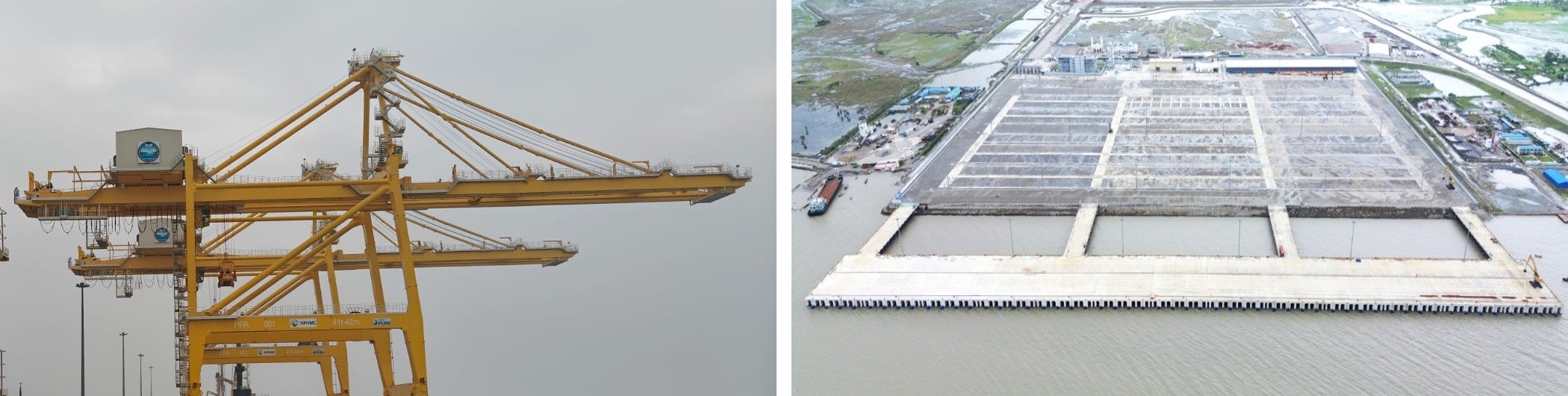
The Shipping Minister informed Parliament on 22 April 2026 that the first terminal’s jetty and yard had been completed, with space for three 200-metre ships. Cargo-handling equipment, storage and service-jetty facilities have also been developed. The 6.35 km six-lane access road and 1.18 km four-lane Andharmanik bridge were targeted for completion by December 2026. That target is not evidence that they are already open to commercial traffic. [4,5]
The first terminal must now be brought into integrated service with customs, equipment, navigational access, utilities and road connectivity. The actual ability to berth vessels will depend on their dimensions, draft and the prevailing marine conditions.
How Payra compares with Chattogram and Mongla
The three ports serve different markets. Chattogram has the largest established shipping network; Mongla serves the southwest and has an existing rail connection; Payra has a developing southern hinterland and a predominantly bulk-cargo base. Competition should therefore be assessed by total logistics cost and service reliability rather than port size alone.
| Indicator | Chattogram | Mongla | Payra |
|---|---|---|---|
| Cargo, FY2025–26 | 137.74m tonnes | 12.25m tonnes | 5.51m tonnes |
| Vessel calls, FY2025–26 | 4,324 | 815 | 29 foreign; 2,962 total* |
| Containers, FY2025–26 | 3,518,841 TEU | 29,714 TEU | Not verified; regular service not established |
| Navigation benchmark** | Up to 10 m draft at river terminals | 8–8.5 m at jetties (tidal) | 6.0–6.9 m at Kawar Char, Nov 2026 (tidal) |
| Cargo profile | Containers, dry and liquid bulk | Bulk, vehicles, containers | Mainly coal; limited other cargo |
| Connectivity | Established road, rail and river logistics | Padma Bridge corridor, rail and river | Padma Bridge corridor and inland waterways; no direct rail |
Sources: FY26 port-authority figures reported by Financial Express, BSS/TBS and The Daily Star; navigation: national strategy and November 2026 reporting. [2,5–9] *Payra total includes inland vessels; not directly comparable. **Indicative historical/dated figures, not voyage-planning limits.
The central problem: rapid loss of navigability
The 75 km Rabnabad dredging scheme removed approximately 64 million m³ in capital works and a further 54 million m³ during maintenance, illustrating the scale of sedimentation. The November 2026 approved draft matrix, as reported on 9 November, restricted ships crossing Kawar Char to 6.0–6.9 m depending on tide. [2,9]
Source: PPA vessel-call figures reported in The Business Standard. [5]
Foreign vessel calls declined from 123 in FY2023–24 to 29 in FY2025–26, even as cargo throughput rose. Much of the cargo is coal carried through lightering. This makes tonnage alone a misleading measure of the port’s progress. The national strategy estimates around US$40 million in additional annual coal logistics costs without maintenance dredging, assuming eight million tonnes of coal imports. This is a modelled scenario, not an audited loss. [2,5,8]
Where Payra can compete, and where it cannot
| Competitive advantages | Competitive disadvantages |
|---|---|
| New multipurpose infrastructure and room for purpose-built terminals and industrial sites. | Uncertain channel depth and high recurring dredging requirements undermine reliable vessel access. |
| Potentially shorter inland journeys for cargo destined for Barishal and Patuakhali, depending on origin. | Established trade networks, container services and ancillary businesses are much stronger at Chattogram and Mongla. |
| Nearby power plants provide a base of bulk cargo; regional industry can diversify demand. | Concentration in coal exposes revenue to a narrow cargo base; lightering adds handling costs. |
| Padma Bridge connectivity and inland waterways offer options for southern and central markets. | No direct railway; road and terminal interfaces must be fully commissioned; coastal cyclone exposure. |
Payra should not attempt to replicate Chattogram immediately. Chattogram is expanding through Bay Terminal, for which the World Bank approved US$650 million in marine infrastructure financing in 2024. Mongla already has established vehicle, bulk and container businesses. Payra’s strongest near-term opportunity is to serve cargo that can be moved more economically through the southern corridor. [2,10]
Future potential: an industrial port, not just a cargo terminal
The national strategy identifies approximately 1,220 acres for port-oriented industrial development and sets out longer-term container, liquid bulk and ship repair facilities. Separately, BEPZA is developing the 410.78-acre Patuakhali Export Processing Zone, with 306 proposed plots. These are distinct initiatives. They offer a basis for future industrial demand but do not guarantee cargo volumes or investment. [2,11]
Investment opportunities for local and foreign companies
Bangladesh’s official PPP project records list a Payra container terminal project; the national strategy identifies two dedicated container-terminal projects approved in principle in March 2024. The earlier coal/bulk PPP initiative was subsequently pursued through alternative financing for power-sector jetties. Investment packages must reflect actual demand rather than duplicate existing capacity. [2,12]
| Opportunity | Suitable structure and investment case |
|---|---|
| Multipurpose terminal operations | Competitive operating concession / O&M; private equipment, systems and productivity commitments. |
| Container terminal expansion | Phased PPP / DBFOT; develop only against credible cargo forecasts and carrier commitments. |
| Grain and dry bulk logistics | PPP or private lease; silos, conveyors, food-grade storage and contracted throughput. |
| Liquid bulk and industrial terminals | Joint venture or build-operate-transfer; tank farms, pipelines, safe segregated berths and committed users. |
| Port industrial area | Long-term land lease / private or joint-venture FDI; steel processing, cement, food processing, logistics, ship repair and renewable power where feasible. |
| Channel maintenance | Performance-based service contract or PPP subject to economic appraisal; payment linked to verified channel availability. |
Indicative investment concepts, not a list of awarded projects. DBFOT = design, build, finance, operate and transfer; O&M = operation and maintenance.
For the port industrial area, the Government should first confirm zoning and land availability, then develop serviced plots with power, water, drainage, wastewater treatment and common logistics. More specialised investment, including vehicle assembly, regulated recycling and energy projects, should follow demonstrated market demand and environmental assessment. No special economic zone status or tax exemption should be presumed before formal designation.
A policy package to make Payra commercially functional
Shipping lines and cargo owners need a reason to choose Payra voluntarily. The Government should launch a coordinated, time-bound competitiveness programme led by the Ministry of Shipping, with the port authority, NBR, transport agencies and investment authorities.
1. Introduce promotional port tariffs. The government should introduce a special discounted tariff for ships calling at Payra Port for an initial period of one to two years. The discounts may include port dues, berthing charges, pilotage fees and other applicable port service charges. This initiative would encourage shipping lines, importers and exporters to use Payra Port instead of relying solely on Chattogram and Mongla ports. The effectiveness of this policy should be reviewed periodically based on the increase in vessel calls, cargo handling volume and overall port revenue.
2. Provide targeted customs incentives. NBR and the Ministry of Finance should examine legally permissible, temporary duty rebates or equivalent logistics incentives for eligible cargo actually shipped through Payra. Any relief requires fiscal, legal and trade-obligation review, safeguards against diversion and a formally issued instrument. Faster clearance and lower port charges may be preferable to broad duty reductions. [13]
3. Guarantee competitive turnaround times. Publish a service-level agreement with cargo-specific berthing windows, handling rates and maximum turnaround targets. For a pilot container service, test a 24–36-hour port stay for agreed call sizes, subject to safe navigation, weather and documentation. Offer tariff credits for delays attributable to the port. Targets are proposals, not existing performance.
4. Ensure adequate navigational depth through continuous maintenance dredging. The government should allocate a dedicated annual budget for maintenance dredging to ensure that the navigational channel of Payra Port remains accessible to ships throughout the year. Detailed sedimentation studies and regular hydrographic surveys should be carried out to determine the actual dredging requirements. Before investing in new dredgers, a comprehensive technical and economic assessment should be conducted to identify the most cost-effective option among purchasing dredgers, hiring dredgers and engaging experienced dredging contractors. Any further deepening of the navigational channel should be justified by projected cargo volumes, vessel requirements, recurring maintenance costs and long-term economic benefits.
5. Build the cargo and logistics network. Secure anchor-customer agreements with power, food, manufacturing and logistics businesses. Launch scheduled barge and feeder services where demand supports them; complete road commissioning, establish round-the-clock customs and digital pre-arrival clearance, and appraise rail investment only against credible demand.
6. Invite investment transparently. Prepare bankable PPP packages under applicable legislation, competitive tenders and clear land-title and utility arrangements. Provide a single investment desk and allocate demand, dredging and currency risks to parties able to manage them. Avoid unconditional public guarantees; protect coastal communities, fisheries and cyclone resilience. [14]
7. Measure results publicly. Issue a monthly dashboard of declared draft availability, foreign ship calls, cargo mix, berth productivity, turnaround, cargo dwell and dredging cost per tonne. Tie further investment to verified results.
Payra’s success should be judged by ships served, cargo delivered at competitive cost, and productive industrial investment, not by the amount of construction completed. Restoring reliable access and winning repeat customers must come before ambitious expansion.
References
- PPA: official history and development programme
- Ministry of Shipping, National Port Strategy 2026, Vol. I, pp. 2–3, 26, 33–38
- Jan De Nul: capital dredging completion (2023)
- BSS: Shipping Minister’s parliamentary statement (22 Apr 2026)
- TBS: Payra navigability and FY26 figures (Oct 2026)
- Financial Express: CPA FY26 statistics (2 Jul 2026)
- BSS: Mongla FY26 results (23 Sep 2026) / TBS (Nov 2026)
- The Daily Star: Payra FY26 reporting (19 Sep 2026)
- Dhaka Stream: November draft matrix (9 Nov 2026)
- World Bank: Bay Terminal financing (28 Jun 2024)
- BEPZA: Patuakhali EPZ project profile
- PPP Authority: Payra container terminal project profile
- NBR: Customs Act, 2023 (official English text)
- PPP Authority: applicable legislation and guidance
Disclaimer: All views, analysis and information in this article are solely the author’s own. Maritime News BD bears no responsibility for them.