

In Depth: this feature brings together published reports and official statements, listed under Sources. Sections marked “Analysis” are Maritime News BD’s interpretation and are not reported facts.
The starting point
Bangladesh settled its maritime boundary disputes with Myanmar in 2012 and India in 2014, securing sovereign rights over 118,813 sq km of the Bay of Bengal, bdnews24.com noted in a June 2026 analysis. The offshore area is divided into 26 blocks, 11 in shallow water and 15 in deep water. Only one offshore field has ever produced: Sangu, in Block 16, from 1998 to 2013, with reserves revised down from about one trillion cubic feet to about 580 billion.
A record of exits
According to the same report, six shallow-water blocks awarded under 1974 contracts were abandoned when commercial reserves could not be confirmed. ConocoPhillips gave up deep-sea blocks DS-10 and DS-11 in 2015, citing unfavourable financial terms, and Santos withdrew from shallow-water block SS-11 in 2020. In 2023 The Financial Express reported that only two shallow-water blocks, SS-04 and SS-09, were under production sharing contracts, both with India’s ONGC Videsh and Oil India.
Data that took years to arrive
A 2D multi-client seismic survey by a TGS and Schlumberger joint venture was awarded in 2018 but delayed by Covid-19 and an oil price collapse, The Financial Express reported in June 2023. TGS later said the survey, completed in April 2023, covered more than 75,000 sq km and 12,636 line-km across the blocks offered, and that the Bengal Fan “remains largely unexplored”, UNB reported in May 2024. Former BAPEX managing director Md Amzad Hossain told bdnews24.com that surveys since 1975 total about 32,000 line-km with roughly a dozen wells, and that the data has not been properly analysed at home.
The 2024 round and the 2026 terms
Seven companies, including ExxonMobil, Chevron, Inpex, PTTEP, CNOOC, KrisEnergy and ONGC, bought documents in the 2024 round, but none submitted a bid. The new Model PSC 2026 allows full profit repatriation, removes signature bonuses and royalties, links gas prices to Brent crude and allows cost recovery of up to 100 per cent, capped at 75 per cent a year; bids can be submitted until 30 November, bdnews24.com reported. Meanwhile, neighbours moved ahead: Myanmar has produced gas from the Shwe field since 2014, and India began deep-water production in the Krishna-Godavari basin in 2024.
Why it matters
Domestic gas supply is about 3.6 to 3.8 billion cubic feet a day, of which 700 to 800 million comes from imported LNG, and imports meet about 62 per cent of primary energy needs, analyst Shafiqul Alam told bdnews24.com. Experts quoted were cautious: Prof Ijaz Hossain said “there is no 100 percent guarantee that exploration will lead to gas discoveries”, and Amzad Hossain said the chances of strong interest were low.
Analysis
The pattern in the record is that terms, data and timing have rarely lined up: terms were judged unattractive when interest existed, and survey data arrived years late. The 2026 terms address the fiscal complaints companies made in the past. Whether that is enough depends on factors outside Bangladesh’s control, including global oil prices and companies’ appetite for frontier deep-water exploration. Even with a successful round, the reports suggest first gas would be years away, so LNG import capacity remains central to near-term supply.
Source
- bdnews24.com: “Why Bangladesh lags behind India and Myanmar in offshore oil, gas exploration” (3 June 2026)
- The Daily Star (UNB): “Untapped petroleum potential: Offshore areas of Bangladesh largely unexplored, says TGS” (10 May 2024)
- The Financial Express: “Bay survey completes one-third, gas reserves rollout awaited” (16 June 2023)
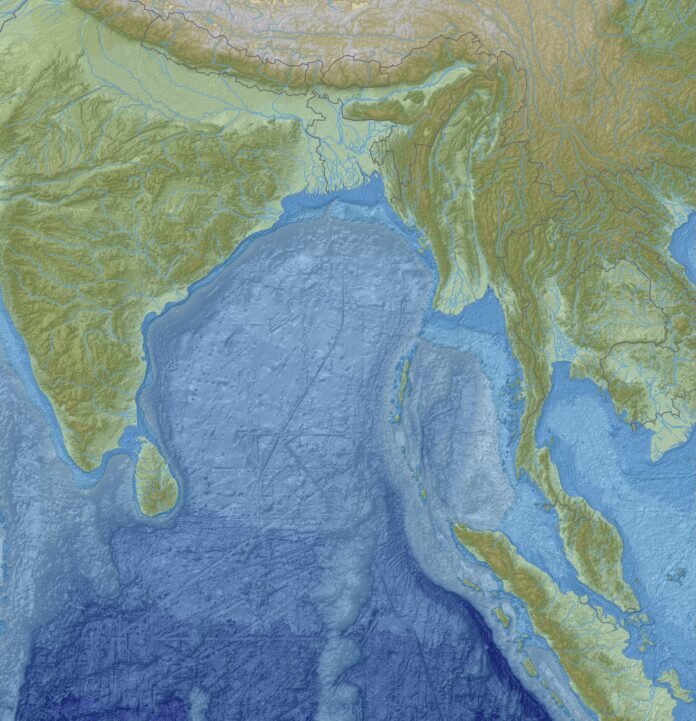
File photo: a relief map of the Bay of Bengal. Photo: Tausheef Hassan Auntu / Public domain, via Wikimedia Commons
This article was prepared by Maritime News BD from the report(s) and documents listed above; it was not independently reported by Maritime News BD.