

A peer-reviewed study of ten commonly eaten “trash fish” species from Bangladesh’s eastern coast in the northern Bay of Bengal has found microplastic contamination in all of them, with possible implications for human health and for aquaculture feed. The paper was published online on 17 April 2026 in the journal Frontiers of Environmental Science & Engineering.
Who did the research
The authors are from WorldFish in Dhaka, Noakhali Science and Technology University, Habiganj Agricultural University and institutions in Australia, Malaysia and Brunei; the corresponding author is M Belal Hossain of NSTU.
Key findings
The tongue sole Cynoglossus arel had the highest contamination, at 2.00 particles per gram in muscle and 5.00 per gram in the gut. Fibres made up 76.9 to 100 per cent of particles, most under 0.5mm, and the main polymers were polyethylene (32 per cent), PET (24 per cent) and polypropylene (18 per cent), linked to textiles, packaging and fishing gear. A pollution load index of 1.32-1.84 indicates moderate contamination. Estimated dietary intake was 3.12 particles per kg of body weight a day for children, against 1.08 for adults.
Why it matters
The authors note that because these low-value fish are also used in fishmeal, microplastics may move into the farmed seafood chain. The study adds to findings from a 2025 deep-sea survey that reported plastic waste at depths of up to 2,000 metres in Bangladesh’s waters.
Sources
- Frontiers of Environmental Science & Engineering (Springer / Higher Education Press): “Characteristics and risks of microplastic contamination in marine trash fish from the northern Bay of Bengal” (published online 17 April 2026)
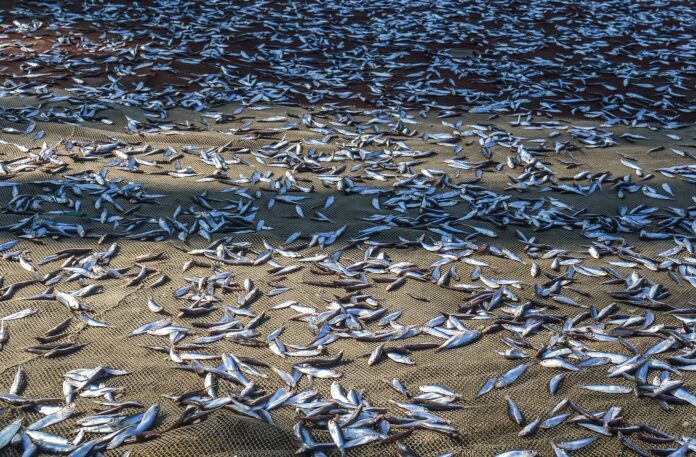
File photo: fish drying in the sun at Cox’s Bazar. Photo: Syed Sajidul Islam / CC BY-SA 4.0, via Wikimedia Commons
This article was prepared by Maritime News BD from the report(s) and documents listed above; it was not independently reported by Maritime News BD.