

Maritime News BD In Depth. Reported facts are attributed to the sources listed at the end. Sections marked as analysis are the views of Maritime News BD.
Every year hundreds of young Bangladeshis graduate from maritime academies in white uniforms, ready to join the world’s merchant fleet. For those who find a ship, seafaring can be one of the best-paid careers open to them, and a valuable source of foreign exchange for the country. For many others, the wait for a first berth stretches for months or years. Bangladesh has the ingredients of a major seafaring nation: training institutions, an English-language tradition in maritime education and a large young population. But it has struggled to convert training into jobs at sea.
Key facts at a glance
- Remittances: nearly $750 million a year from the marine sector, according to the Bangladesh Mariners’ Community (UNB, July 2025).
- Training output: several hundred officer-track graduates a year (Daily Star opinion).
- Sea-time requirement: typically more than 12 months on board before a first Certificate of Competency.
- Standards: Bangladesh is on the IMO White List under the STCW Convention.
- Recent case: Banglar Joyjatra crew stranded about 115 days in the Gulf in 2026 (Prothom Alo).
Why seafarers matter to the economy
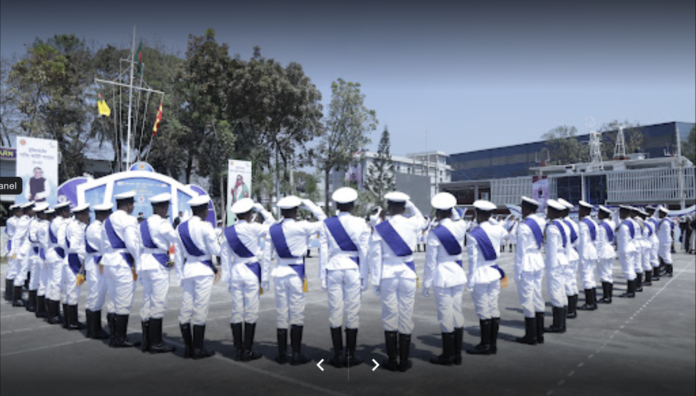
At a protest in Dhaka in July 2025, the Bangladesh Mariners’ Community said the marine sector brings in nearly $750 million a year in remittances, UNB reported. At a passing-out parade at the Bangladesh Marine Academy in Pabna in December 2025, the shipping ministry’s chief guest said a single marine officer earns foreign exchange equivalent to about 50 unskilled workers, BSS reported.
Those figures explain why governments have expanded maritime education. Alongside the original Bangladesh Marine Academy in Chattogram, new government marine academies have been set up in other divisions, including Pabna, and private institutes also train cadets. In December 2025, 65 cadets, 33 in the nautical stream and 32 in marine engineering, took part in the passing-out parade of the Pabna academy’s fourth batch, according to BSS.
The bottleneck: sea time
Graduating from an academy is only the first step. To earn a first Certificate of Competency (CoC) as an officer, a cadet must complete a period of supervised sea service, typically more than 12 months, on board a ship. In a Daily Star opinion piece, Ahamedul Karim Chowdhury, adjunct faculty at Bangladesh Maritime University, wrote that Bangladesh’s training pipeline produces several hundred officer-track graduates a year, while the supply of training berths lags far behind. Many cadets wait a long time for that first ship.
The Bangladeshi-flagged fleet is too small to absorb all of them, so most must find places with foreign shipowners and manning agencies. That brings a second obstacle: visas.
Visas and mobility
Chowdhury noted that Bangladeshi cadets often cannot use seafarer identity documents to travel to crew-change ports without first obtaining work visas, unlike cadets from many other countries. That makes it hard for them to attend interviews or join ships at short notice, when vacancies often arise. The Mariners’ Community also listed visa problems among its five demands in 2025, UNB reported.
Standards: protecting the IMO White List
Bangladesh is on the IMO’s “White List” of countries that give full and complete effect to the STCW Convention, the international standard for seafarer training and certification. Losing that status would make Bangladeshi certificates far less attractive to shipowners.
That concern was at the centre of the July 2025 protest. Mariners opposed a proposal from the expatriates’ welfare ministry to issue Continuous Discharge Certificates (CDCs) to holders of an SSC-level diploma for officer cadet positions. Speakers said the diploma is not recognised under STCW Code A-III/1 and warned that the move could put the White List status at risk, according to UNB.
The risks of the job: the Banglar Joyjatra
Seafaring also carries real risks. In 2026 the crew of the state-owned Bangladesh-flagged ship Banglar Joyjatra spent about 115 days stranded in the Persian Gulf after hostilities broke out involving Iran shortly after the ship arrived at Jebel Ali in late February, Prothom Alo reported. The ship crossed the Strait of Hormuz on the night of 23 June with permission from Iranian authorities, and the crew flew home from Durban, arriving in Dhaka on 21 July. The episode was a reminder that welfare, repatriation and insurance arrangements are as important to seafarers as wages.
What other seafaring nations do
Chowdhury’s article pointed to international examples. Vietnam built a training centre with the Dutch STC Group and a Ho Chi Minh City university, offering industry-aligned training, simulators and placement with European shipowners. The Philippines, the world’s largest supplier of seafarers, matches maritime school admissions to forecast vacancies. India coordinates the placement of large graduate cohorts into foreign fleets.
Editorial analysis: from training numbers to careers
The following is Maritime News BD’s analysis, based on the reporting above.
1. Match intake to berths. Training more cadets than the market can absorb wastes public money and young people’s time. Setting academy intakes against realistic forecasts of training berths, as the Philippines does and as Chowdhury recommends, would raise the value of every certificate issued.
2. Make the passport work. Negotiating seafarer mobility arrangements with major crew-change hubs such as the UAE, Singapore and Hong Kong, so that cadets with valid seafarer documents can join ships without full employment visas, could open more jobs than building another academy.
3. Guard certification integrity. The White List is a national asset. Any change to who receives CDCs or CoCs should be tested against STCW requirements first, and sea-time records should be verifiable.
4. Use the waiting period. Short courses in simulator training, English, digital navigation and safety, which Chowdhury calls “warm-hold” courses, can keep graduates employable while they wait.
5. Build placement capacity. A national placement portal under the Department of Shipping and Bangladesh Maritime University, with oversight of manning agents to prevent exploitation, was among Chowdhury’s recommendations. It would also give policymakers better data on how many graduates actually reach sea.
6. Link the workforce to the wider maritime economy. Graduates who cannot go to sea immediately could fill skills gaps ashore, in port operations at the new Chattogram terminals, in shipyards and ship recycling safety roles, and in the offshore sector if exploration expands.
Opportunities
- Global demand for qualified officers, especially as fleets adopt new fuels and digital systems that require new skills.
- Partnerships with European and Japanese shipowners seeking reliable crew sources.
- Higher remittance income per worker than most other overseas employment.
- Shore-based careers in ports, shipbuilding, ship recycling and maritime services.
Risks
- Graduate unemployment and frustration if intakes keep outpacing berths.
- Loss of White List status if training or certification standards are weakened.
- Exploitation by unregulated manning agents.
- Safety and welfare risks in conflict zones, as the Banglar Joyjatra crew experienced.
Conclusion
Analysis: Bangladesh does not lack people willing to go to sea. What it needs is a system that turns training into careers: realistic intakes, guaranteed paths to sea time, easier mobility, strict standards and support when things go wrong. Get those right, and seafarers could become one of the country’s most valuable maritime assets, worth far more than the remittances they send home.
Figures are as reported by the cited sources. Maritime News BD has not independently verified remittance estimates.
Sources
- BSS: “Passing out parade of Pabna Marine Cadets held” (8 Dec 2025)
- UNB: “Mariners protest against proposed CDC issuance to diploma holders” (2 Jul 2025)
- The Daily Star (opinion): “How Bangladesh can secure global jobs for maritime graduates” (2025)
- Prothom Alo: “Crew of Banglar Joyjatra return home” (21 Jul 2026)
File photo: Officer cadets at a Bangladesh Marine Academy graduation and passing-out parade. Photo: Lal Shôbuz Bengal Tigers / CC BY-SA 4.0, via Wikimedia Commons
This article was prepared by Maritime News BD from the report(s) and documents listed above; it was not independently reported by Maritime News BD.