

Maritime News BD In Depth. This feature separates reported facts, attributed to the sources listed at the end, from our own editorial analysis, which is clearly labelled.
For almost two decades Bangladesh has been told that shipbuilding could become “the next garments”: a labour-intensive export industry that turns a long coastline, a river-building tradition and low wages into foreign exchange. The numbers so far tell a more modest story. In the fiscal year that ended in June 2026, ship exports came to about $22.53 million, according to Export Promotion Bureau figures reported by bdnews24.com. That is a sharp recovery from $2.94 million a year earlier, but it is still far below the industry’s own best year, and a tiny fraction of the $4 billion annual export target set in the government’s 2021 shipbuilding policy.
So can Bangladesh become a global shipbuilding hub? The honest answer is: not in the way China, South Korea or Japan are, and probably not soon. But there is a narrower and more realistic opportunity in small and medium-sized vessels, and the choices made over the next few years will decide whether the sector captures it.
Background: a stop-start export story
Bangladesh’s first ship export took place in 2008, when shipments were worth about $40.44 million, bdnews24.com reported. Exports peaked at $65.61 million in FY2016-17. They then collapsed: according to the same report, there were no ship exports at all in FY21, FY22 and FY24. The Daily Star, citing industry data in August 2025, put the total since 2008 at more than 50 vessels worth about $143 million.
The export base is extremely narrow. bdnews24.com reported that only two yards, Ananda Shipyard and Slipways and Western Marine Shipyard, have exported vessels. Western Marine told The Financial Express in October 2025 that it had delivered 36 ships to 12 countries worth about $140 million, operates five slipways, employs more than 1,000 workers and can build eight to ten ships a year. It has since delivered six vessels to the United Arab Emirates within roughly 18 months and has five larger ships in preparation, according to bdnews24.com. Ananda exported a vessel to Turkey in September 2025 but has since faced financial difficulties, the same report said.
Other yards are growing too. The Daily Star reported in 2025 that Karnafuly Ship Builders had secured a $47 million order for green vessels from the Netherlands, and that the industry had an order book of about $100 million with roughly $200 million more in the pipeline.
Where Bangladesh stands in a concentrated global market
Global shipbuilding is dominated by three countries. A December 2025 opinion article in The Business Standard by Captain Sayeed M Hassan, citing UNCTAD data, noted that China, South Korea and Japan together account for about 95% of world shipbuilding output. Maritime Executive reported in July 2026 that China alone held about 72% of new orders. These yards build very large container ships, tankers and LNG carriers in dry docks that Bangladesh does not have.
Bangladeshi yards, by contrast, typically build vessels of up to around 10,000 to 12,000 tonnes. The Financial Express reported in June 2026, in a story on shipbuilding being treated as a thrust sector, that yards can build ships of up to 12,000 tonnes and that local value addition is currently about 25 to 30%, with industry leaders saying it could rise to 45 to 50%.
Economist Zaidi Sattar, chairman of the Policy Research Institute, has estimated the global market for small and medium vessels at about $115 billion, bdnews24.com reported. In 2025 he told The Daily Star that the $4 billion goal was unrealistic and suggested a target of about $1 billion within three to five years.
Policy support: announced, but under-used
The state has offered support on paper. In May 2022 Bangladesh Bank created a Tk 2,000 crore (Tk 20 billion) refinancing fund for the sector at a 4.5% interest rate. bdnews24.com reported in July 2026 that the fund had gone unused. The Financial Express reported in June 2026 that loans at around 4% were being discussed as part of thrust-sector treatment.
The government has also started looking at the regulatory framework. On 13 August 2026, officials held meetings on making the shipbuilding and ship recycling industries safe and sustainable, The Business Standard and UNB reported. In July 2026, Ship & Offshore reported that a proposed $1 billion green shipbuilding and repair dockyard at Matarbari had received in-principle approval. In October 2026, UNB reported that Chittagong Dry Dock Limited (CDDL) was pursuing a hybrid guarantee model and a design centre in cooperation with Norway and the Netherlands, while noting that CDDL still needs larger cranes and docks.
Editorial analysis: why the target keeps slipping
The following section is Maritime News BD’s analysis, based on the reporting above.
1. Finance, not labour, is the binding constraint. Export shipbuilding requires yards to fund construction for 12 to 24 months before final payment. Foreign buyers expect refund guarantees from banks they trust. A refinancing fund that sits unused suggests that the problem is not the interest rate but access: collateral rules, bank risk appetite and the absence of an internationally accepted guarantee mechanism. CDDL’s hybrid guarantee idea is a step in the right direction, but it needs to be scaled up and backed by a credible institution.
2. Two exporters are not an industry. When one of only two exporting yards runs into financial trouble, national export figures swing wildly, as the zero years show. A hub needs a cluster of yards, suppliers, design houses and classification surveyors. The planned design centre and the Matarbari dockyard proposal could help, but only if they bring in more firms rather than concentrating work in one place.
3. Low local value addition limits the gains. If engines, steel plate, navigation systems and much of the outfitting are imported, a $20 million export may leave only $5 to 6 million of value in Bangladesh. Raising local content to the 45 to 50% that industry leaders describe requires steel plate of marine grade, certified welders and component makers, which in turn depend on stable order volumes.
4. The home market is under-used. Captain Hassan’s TBS article noted that Bangladeshi private owners had bought more than 60 ships since 2018, largely from abroad rather than from Bangladeshi yards. Linking domestic fleet expansion, including Bangladesh Shipping Corporation’s plans, to local yards would give builders a stable base load and a track record that export buyers want to see.
Opportunities
- Niche vessels: coasters, small tankers, tugs, ferries, fishing vessels, offshore support boats and inland container vessels, where Bangladeshi yards have proven designs and price advantages.
- Green ships: European buyers are ordering hybrid and low-emission small vessels. The Karnafuly order from the Netherlands shows that this market is open to Bangladesh.
- Repair and maintenance: a modern repair dock at Matarbari or Chattogram could earn steady income from the growing number of ships calling at Bangladeshi ports and passing through the Bay of Bengal.
- Defence and public procurement: local construction of naval and government vessels, as Dockyard and Engineering Works and Khulna Shipyard already do, can build skills that carry over into commercial work.
Risks
- Financial fragility: a single delayed payment can push a yard into default, as Ananda’s experience shows.
- Safety and compliance: the August 2026 government review was prompted partly by concerns about workplace safety in both shipbuilding and ship recycling. International buyers increasingly audit labour and environmental standards.
- Competition: Vietnam, India, Indonesia and Turkey are all chasing the same small and medium vessel market, often with stronger state backing.
- Infrastructure: without larger docks, cranes and deep-water access, Bangladesh cannot move up to larger vessels.
What would a realistic path look like?
Analysis: A credible medium-term goal is closer to Zaidi Sattar’s $1 billion in exports over several years than to $4 billion a year. Reaching it would likely require four things: a working export guarantee scheme with real banks behind it; a domestic procurement link so that state-owned fleets order from local yards; skills programmes for welders, naval architects and marine engineers, with international certification; and at least one modern dock capable of building and repairing larger vessels.
FY26’s recovery to $22.5 million shows that orders can return quickly when yards are financially healthy. The question for policymakers is whether they can turn a good year into a steady pipeline. Until the export base is broader than two yards, and until finance reaches the shipyards that need it, “global hub” will remain an aspiration rather than a forecast.
Figures in this article are as reported by the cited sources on the dates shown. Maritime News BD has not independently audited company or government data.
Sources
- bdnews24.com: “Report on FY2025-26 ship export earnings (EPB data)” (13 Jul 2026)
- The Daily Star: “Report on the $4bn shipbuilding export goal and the sector order book” (16 Aug 2025)
- The Financial Express: “Western Marine delivers three ships to UAE” (23 Oct 2025)
- The Business Standard: “Leveraging fleet expansion to build national shipbuilding capacity (opinion)” (26 Dec 2025)
- The Business Standard / UNB: “Initiative taken to make shipbuilding, recycling industries safe” (14 Aug 2026)
- Ship & Offshore: “Report on the proposed Matarbari shipbuilding and ship repair hub” (Jul 2026)
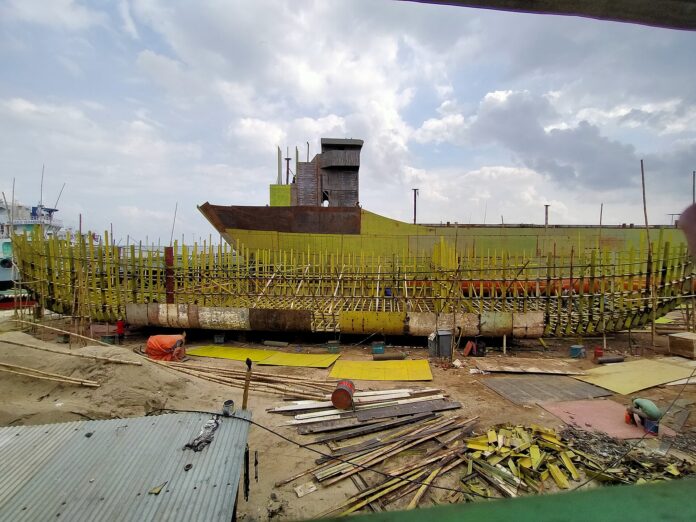
File photo: A ship under construction at a dockyard on the banks of the Meghna River, Bangladesh. Photo: Salim Khandoker / CC BY-SA 4.0, via Wikimedia Commons
This article was prepared by Maritime News BD from the report(s) and documents listed above; it was not independently reported by Maritime News BD.