

Maritime News BD In Depth. Reported facts are attributed to the sources listed at the end. Sections marked as analysis are the views of Maritime News BD.
Almost every garment shipped from Bangladesh, and almost every container of machinery, food or raw material that arrives, passes through one port. Chattogram handled about 92% of Bangladesh’s total import-export cargo and 98% of its containerised trade in 2025, bdnews24.com reported. That concentration has served the country for decades, but it is also its biggest logistical risk. The government’s answer is a four-port strategy built around Chattogram, Mongla, Payra and the new deep-sea port at Matarbari, plus new terminals at Chattogram run by foreign operators. This feature looks at where each project stands and whether the plan adds up.
Chattogram: record volumes, limited room
In calendar year 2025 Chattogram Port handled 3.409 million TEU (twenty-foot equivalent units), up about 4% from 2024, according to bdnews24.com. Revenue rose 7.55% to Tk 54.6 billion, 4,273 vessels called, and bulk cargo reached 138.15 million tonnes.
The port’s main constraint is physical. The Karnaphuli river channel limits the size of ships that can enter. The Business Standard reported in July 2026 that the port’s current practical limit is about 2,700 TEU per vessel. Most Bangladeshi containers are therefore carried on small feeder ships to transhipment hubs such as Colombo, Singapore or Port Klang, where they are transferred to large mainline vessels. Every extra handling step adds time and cost for exporters.
New terminals at Chattogram: Laldia and the Bay Terminal
Laldia. In November 2025 the Chittagong Port Authority signed a 30-year concession with APM Terminals, part of the Maersk group, to build and operate the Laldia container terminal. TBS reported on 30 July 2026 that the $550 million project, described as Bangladesh’s first fully foreign-invested container terminal, will have capacity of more than 800,000 TEU a year, raising Chattogram’s container capacity by nearly 23%. It is designed for ships of up to 6,000 TEU, with a 613-metre quay and a 10.5-metre draught. Construction is expected to begin by the end of 2026, subject to approvals, with full operation expected by 2030.
Bay Terminal. The larger Bay Terminal project, outside the river mouth at Patenga, is planned as three terminals totalling 4.95 km. bdnews24.com reported in May 2024 that Abu Dhabi Ports Group had signed an MoU to invest $1 billion in the multipurpose terminal, with Singapore’s PSA and Dubai’s DP World expected to invest in the two container terminals. A six-kilometre breakwater and access channel are to be financed by the World Bank. The terminal was then expected to open in 2026; that timeline has slipped.
Matarbari: Bangladesh’s first deep-sea port
About 100 km south of Chattogram, the Matarbari deep-sea port is being built with Japanese assistance next to an existing coal power plant at Maheshkhali. India Seatrade News reported in July 2026 that the shipping minister told parliament the port remains on schedule to begin operations in 2029. It will have a 16-metre-deep channel and will be able to handle container ships of about 8,200 TEU and bulk ships of up to 100,000 DWT, a first for Bangladesh.
That size matters. Ships of 8,000 TEU could, in principle, connect Bangladesh directly to regional and long-haul services, reducing dependence on transhipment hubs.
Mongla: a record year in the south-west
Mongla, near the Sundarbans, has grown rapidly since the Padma Bridge opened in 2022 and shortened road links to Dhaka. According to Maritime Gateway, Mongla Port earned a record Tk 387.95 crore in FY2025-26. It handled 29,714 TEU, up 38.5% year on year, and about 12.25 million tonnes of cargo, while 815 vessels called. An upgrade financed under India’s third Line of Credit includes two container terminals and new yards, and the port is procuring tugs, a survey vessel and other craft for completion by June 2027.
Payra: the siltation problem
Payra, in Patuakhali, was planned as a major deep-water port but has struggled with its approach channel. In December 2025, Apparel Resources reported that siltation in the 75-km Rabnabad channel had reduced navigable depth to below six metres, even though capital dredging had been completed in April 2024. Foreign vessel arrivals fell to 85 in FY2024-25 from 123 a year earlier, and some coal was being offloaded at anchorages near Chattogram instead. A proposal to buy more dredgers was awaiting approval.
Key figures at a glance
| Port / project | Latest reported figure | Status or timeline |
|---|---|---|
| Chattogram (existing terminals) | 3.409 million TEU in 2025 | Operating; practical ship limit about 2,700 TEU |
| Laldia (APM Terminals) | 800,000+ TEU capacity, $550m | Construction from late 2026; full operation by 2030 |
| Bay Terminal | 4.95 km of quays planned | Delayed from the original 2026 target |
| Matarbari deep-sea port | 8,200 TEU / 100,000 DWT ships | Operations planned for 2029 |
| Mongla | 29,714 TEU, 12.25m tonnes in FY26 | Operating; India-funded upgrade under way |
| Payra | 85 foreign vessels in FY25 | Channel siltation limits larger ships |
Editorial analysis: four ports, one system?
The following is Maritime News BD’s analysis, based on the reporting above.
1. Timing is everything. Laldia is due by 2030 and Matarbari by 2029, while the Bay Terminal has already slipped. Container demand will not wait. If Chattogram’s volumes keep growing at around 4% a year, the existing terminals will be under pressure well before new capacity arrives. Short-term measures, such as better yard management, faster customs clearance and more off-dock capacity, will matter in the meantime.
2. Hinterland links decide a port’s value. Matarbari will need road and rail connections to Chattogram and Dhaka, and enough inland container depot capacity, to attract shipping lines. Mongla’s growth shows what better connectivity can do: the Padma Bridge changed the economics of the south-west.
3. Dredging is not a one-off. Payra’s experience shows that a channel dredged once can silt up quickly in the Ganges-Brahmaputra delta. Any port plan needs a funded, long-term maintenance dredging programme, not just a capital project.
4. Foreign operators bring capital and questions. Concessions to APM Terminals and potential deals with AD Ports, PSA and DP World bring investment, technology and links to global shipping networks. They also raise legitimate questions about tariffs, labour, transparency and national control. Publishing key concession terms would help build public trust.
5. Regional competition is real. Colombo, Visakhapatnam and other regional ports are also competing for Bay of Bengal feeder and transhipment business. Bangladesh’s advantage is its large domestic cargo base; its weakness has been slow dwell times and customs procedures. New quays alone will not change that.
Opportunities
- Larger ships and direct services that cut freight costs and transit times for exporters.
- Regional transit trade for Nepal, Bhutan and north-east India through Mongla and Chattogram.
- Industrial zones around Matarbari and Mirsarai linked to deep-water access.
- Greener terminals, such as Laldia’s electrified equipment, that cut emissions.
Risks
- Project delays that leave Chattogram congested for years.
- Siltation and maintenance costs at Payra and in river channels.
- Under-used capacity if hinterland roads, rail and inland waterways are not built in time.
- Climate risks, including cyclones and sea-level rise, for low-lying port infrastructure.
Conclusion
Analysis: Bangladesh’s port strategy is moving in the right direction, with record volumes at Chattogram and Mongla, a foreign-funded terminal at Laldia under way, and a true deep-sea port at Matarbari scheduled for 2029. But the plan depends on delivering several large projects on time and connecting them to the rest of the economy. Treating the four ports as one system, with shared planning for dredging, hinterland links and customs, will matter as much as any new quay.
Figures are as reported by the cited sources. Timelines are official projections and may change.
Sources
- bdnews24.com: “Report on Chattogram Port 2025 container and revenue figures” (2 Jan 2026)
- The Business Standard: “APM Terminals unveils $550m Laldia terminal layout; construction starts in December” (30 Jul 2026)
- bdnews24.com: “Report on AD Ports MoU for the Bay Terminal” (17 May 2024)
- India Seatrade News: “Report on Matarbari deep-sea port timeline” (Jul 2026)
- Maritime Gateway: “Mongla Port earns record Tk 387.95 crore revenue in FY26” (24 Sep 2026)
- Apparel Resources: “Navigability crisis at Payra port curtails foreign vessel traffic, cargo volumes” (17 Dec 2025)
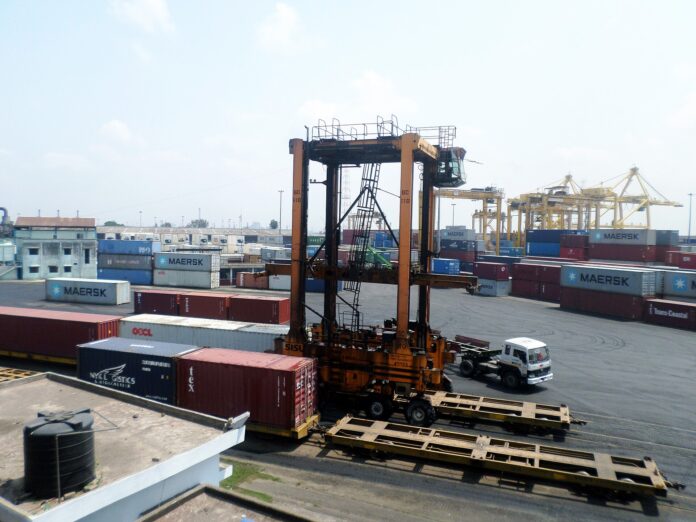
File photo: Container yard at Chittagong Port. Photo: Motiur Rahman Oni / CC BY-SA 4.0, via Wikimedia Commons
This article was prepared by Maritime News BD from the report(s) and documents listed above; it was not independently reported by Maritime News BD.