

In Depth: this feature brings together published reports and official statements, listed under Sources. Sections marked “Analysis” are Maritime News BD’s interpretation and are not reported facts.
What the catch data show
Commercial trawler landings in the Bay of Bengal fell from a record 146,037 tonnes in FY2022-23 to 116,650 tonnes in FY2024-25, a 21 per cent drop, according to Department of Marine Fisheries data reported by The Business Standard in October 2025. Hilsa landings by trawlers fell 78 per cent, from 8,138 to 1,790 tonnes, and sardine-like species 44 per cent. The number of commercially harvested species fell from more than 112 to 55-57. The department’s director of statistics, Moin Uddin, cautioned that one or two years of data cannot show that fish are disappearing, noting that FY25 catch was slightly above FY24.
A small footprint in a large sea
Bangladesh has sovereign rights over 118,813 sq km of sea, but trawlers operate in only about 27,000 sq km, the same report said. The Marine Fisheries Department lists 266 licensed trawlers, about 232 active, alongside some 66,000 smaller boats; the trawler owners’ association says commercial trawlers land about 12 per cent of the marine catch. Bangladesh has never conducted a maximum sustainable yield survey, and the ban on trawling in waters shallower than 40 metres is frequently violated. On tuna, Sri Lanka landed more than 270,000 tonnes of tuna and tuna-like species in 2022 while Bangladesh landed fewer than 3,000 tonnes.
Signals from the 2025 deep-sea survey
A survey aboard the research vessel Dr Fridtjof Nansen from August to September 2025 recorded 65 species new to Bangladesh’s records, but also abundant jellyfish linked to overfishing, plastic at 2,000 metres and fewer large fish than in 2018, bdnews24.com reported in January 2026.
The industry view
In a February 2026 opinion piece in The Business Standard, Tanvir Shahriar Rimon, CEO of Rancon’s sea fishing division, estimated the marine catch at about 700,000 tonnes against a potential of about 7 million, said nearly 70 per cent of the marine catch comes from migratory species and that recorded marine fish species fell from 475 in 1971 to 394. He warned that withdrawing WTO-noncompliant export subsidies after LDC graduation could hurt industrial trawling and argued for green financing and fuel-efficiency incentives instead. These are the author’s views.
Analysis
The sources point in two directions at once: falling catches and warning signs in some stocks, alongside large areas and deep-water species that are barely fished. Without a stock assessment, neither “overfished” nor “untapped” can be stated with confidence for the Bay as a whole. That is why the absence of a maximum sustainable yield survey, and the timing of new research vessels and survey ships now on order, matter for any decision to expand deep-sea or tuna fishing.
Source
- The Business Standard: “Fish catch in Bay drops 21% in three years, hilsa plummets 78%” (8 October 2025)
- bdnews24.com: “Yunus calls for research, global coordination after deep-sea survey finds 65 new aquatic species” (6 January 2026)
- The Business Standard (opinion): “Bangladesh’s deep-sea fisheries: An untapped frontier at a critical crossroads” (22 February 2026)
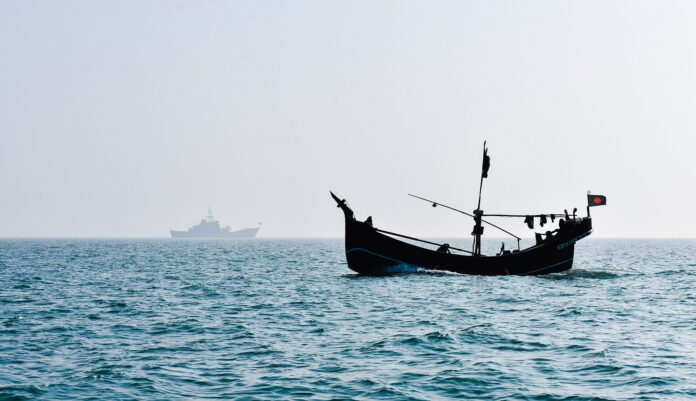
File photo: fishing boats in the Bay of Bengal. Photo: Shakil Ahmed Sarowar / CC BY-SA 4.0, via Wikimedia Commons
This article was prepared by Maritime News BD from the report(s) and documents listed above; it was not independently reported by Maritime News BD.