

Maritime News BD In Depth. Reported facts are attributed to the sources listed at the end. Sections marked as analysis are the views of Maritime News BD.
More than a decade after international rulings settled its sea boundaries with Myanmar (2012) and India (2014), Bangladesh still talks about the “blue economy” mostly in the future tense. The country gained rights over about 118,813 square kilometres of sea, a maritime area comparable in size to its land territory, along a coastline of roughly 710 kilometres. Successive governments have promised that fisheries, shipping, offshore energy, tourism and coastal industries in the Bay of Bengal would become a major engine of growth.
In October 2026, State Minister for Planning Zonayed Abdur Rahim Saki told a seminar at Independent University, Bangladesh (IUB) that marine resources must contribute significantly to GDP if Bangladesh is to become a trillion-dollar economy by 2034, UNB reported. He said a dedicated Blue Economy Cell at the Prime Minister’s Office is coordinating the institutions involved. This feature looks at where the main sectors stand, and what it would take to turn the slogan into measurable results.
Background: from boundary rulings to budget lines
Settling the maritime boundaries gave Bangladesh legal certainty over fishing grounds and offshore hydrocarbon blocks. Progress since then has been uneven. Offshore gas exploration has repeatedly failed to attract strong international interest, deep-sea fishing remains small in scale, and research capacity has been thin.
The FY2026-27 budget set out some concrete steps. According to The Daily Star, the government proposed Tk 200 crore for blue economy research, innovation and development, split between a Blue Economy Research Fund and development work. The budget also set a target of raising fisheries exports to $1 billion by 2030, from about $450 million in FY2024-25, named two new marine protected areas at Kuakata and Salimpur, and announced plans for a modern fishing port at Matarbari and commercial vessels to harvest tuna and other pelagic fish in deep-sea waters.
Fisheries: big inland output, a stressed sea
Bangladesh is already a fish-producing powerhouse, but mostly from rivers, floodplains and ponds. The FAO’s State of World Fisheries and Aquaculture 2026 report, as summarised by Down To Earth, placed Bangladesh second only to India in inland capture, at about 1.4 million tonnes. The same report estimated global fisheries and aquaculture production at about 235 million tonnes and found that 62.4% of assessed marine fish stocks were fished within sustainable levels, meaning more than a third were not.
Signs of pressure in Bangladeshi waters are visible. The Daily Star reported in April 2026 that the average length of hilsa, the national fish, had fallen to about 34.0 cm in FY26, with a Bangladesh Fisheries Research Institute scientist linking the decline to aggressive fishing. A peer-reviewed study published in 2026 in Frontiers of Environmental Science & Engineering reported microplastics in ten species of low-value “trash fish” from the northern Bay of Bengal, fish that are often used for feed or dried for human consumption.
New livelihoods: seaweed and coastal aquaculture
Not all the news is about decline. The Daily Star reported in January 2026 that seaweed farming had grown into a livelihood for about 1,000 households in Cox’s Bazar. Seaweed requires no feed or fertiliser, can absorb nutrients from coastal waters and has markets in food, cosmetics and animal feed. The FY27 budget specifically mentioned expanding seaweed cultivation.
Energy: gas bids and offshore wind
Offshore hydrocarbons remain the biggest potential prize, and the biggest uncertainty. In July 2026 The Financial Express reported that the energy minister had ruled out overseas roadshows for the current offshore bidding round, with bids due on 30 November. Previous rounds attracted limited interest from international oil companies.
Offshore wind is a newer topic. A review published in January 2026 in Oxford Open Energy, indexed by the US Pacific Northwest National Laboratory’s Tethys database, set out a strategic roadmap for offshore wind development in Bangladesh, discussing resource assessment, grid integration and policy needs. Bangladesh has not yet held an offshore wind auction.
Ports and logistics: the blue economy’s backbone
Shipping and ports are the most developed part of the blue economy, and also the place where inefficiency is most costly. At the same October 2026 IUB seminar, IUB trustee Javed Hosein said that unloading a 21,000-tonne fuel oil tanker takes three to five days in Bangladesh compared with four to five hours in Singapore, UNB reported. Projects at Chattogram, Matarbari, Mongla and Payra are intended to close that gap; we examine them in a separate In Depth feature.
Editorial analysis: what will decide the outcome
The following is Maritime News BD’s analysis.
1. Data before ambition. Bangladesh still lacks a regular, published stock assessment for most marine species. Without it, targets such as $1 billion in fisheries exports risk encouraging more fishing pressure on stocks that are already showing stress, as the hilsa length data suggests. Part of the new research fund could usefully go to annual surveys and open data.
2. Protection and production must go together. The new marine protected areas at Kuakata and Salimpur are welcome, but protected areas only work when they are enforced and when coastal fishers are offered alternatives. Seaweed farming, improved fish landing centres and better cold chains could provide those alternatives.
3. Coordination is the hard part. The blue economy cuts across at least a dozen ministries: fisheries, shipping, energy, environment, foreign affairs, defence and planning among them. A coordination cell at the Prime Minister’s Office is only as effective as its authority and budget. Publishing a single action plan with measurable targets and annual progress reports would make accountability easier.
4. Energy decisions carry long consequences. If the November gas bidding round again draws little interest, policymakers will face a choice between better fiscal terms for gas and a faster move into offshore wind. Both require years of preparation, port infrastructure and skilled workers, so decisions taken in 2026 and 2027 will shape the Bay’s energy role for decades.
Opportunities
- Higher-value seafood exports through better processing, traceability and certification.
- Seaweed and coastal aquaculture as climate-resilient livelihoods.
- Offshore gas and, longer term, offshore wind for energy security.
- Port efficiency gains that cut costs for every exporter in the country.
- Marine research and education that build a skilled workforce, a point Saki also emphasised.
Risks
- Overfishing and shrinking fish size, as the hilsa data shows.
- Pollution, including microplastics entering the food chain.
- Climate change: cyclones, sea-level rise and salinity intrusion threaten coastal communities and infrastructure.
- Weak investor interest in offshore energy if terms and data remain unattractive.
- Targets announced without monitoring, which can erode public trust.
What to watch in the coming months
- 30 November 2026: the deadline for offshore oil and gas bids. The number and quality of bidders will show whether investor interest has improved.
- Research fund rules: how the Tk 200 crore is allocated, and whether universities and fisheries institutes can access it competitively.
- Marine protected area management: whether Kuakata and Salimpur receive management plans, staff and patrol capacity.
- Fisheries export data: whether FY27 shows movement towards the $1 billion target, and which products drive it.
Conclusion
Analysis: The Bay of Bengal can contribute much more to Bangladesh’s economy, but the gains are most likely to come from steady improvements, such as better-managed fisheries, faster ports, new coastal livelihoods and credible energy tenders, rather than from a single breakthrough. The FY27 budget and the Blue Economy Cell provide a framework. The test over the next two years will be whether progress is measured and published, and whether the people who live along the coast see the benefits.
Figures are as reported by the cited sources. Maritime News BD has not independently verified government targets or projections.
Sources
- UNB: “Bangladesh must tap marine resources to achieve $1 trillion economy by 2034: Saki” (12 Oct 2026)
- The Daily Star: “Govt sets aside Tk 200 crore for blue economy research, development” (Jun 2026)
- Down To Earth: “Report on FAO State of World Fisheries and Aquaculture 2026” (19 Jun 2026)
- The Daily Star: “Report on shrinking hilsa size due to aggressive fishing” (Apr 2026)
- Frontiers of Environmental Science & Engineering: “Study on microplastics in trash fish from the northern Bay of Bengal” (2026)
- The Daily Star (e-paper): “Report on seaweed farming in Cox’s Bazar” (31 Jan 2026)
- The Financial Express: “Minister rules out overseas roadshows for offshore bids” (20 Jul 2026)
- Tethys (PNNL) / Oxford Open Energy: “Strategic roadmap for offshore wind energy development in Bangladesh: a review” (Jan 2026)
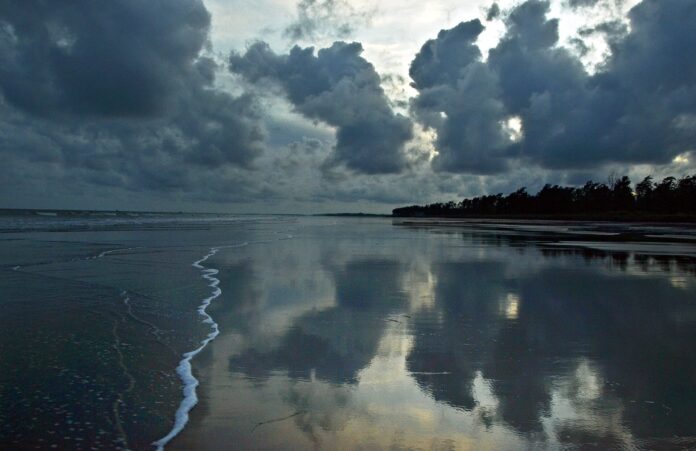
File photo: The Bay of Bengal shoreline, Bangladesh. Photo: Pranab basak / CC BY-SA 4.0, via Wikimedia Commons
This article was prepared by Maritime News BD from the report(s) and documents listed above; it was not independently reported by Maritime News BD.