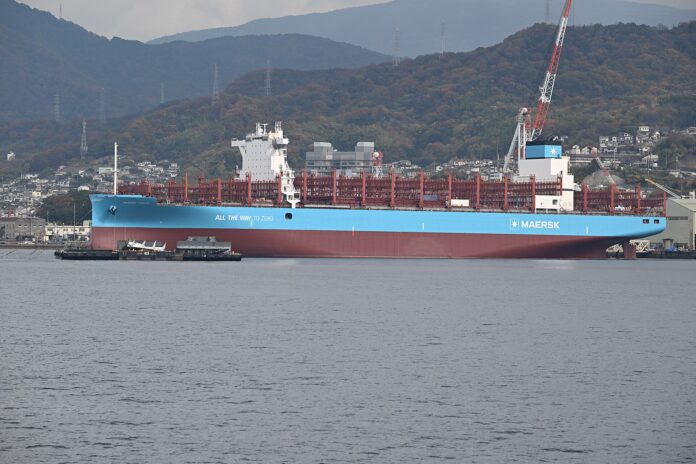
Japan Marine United (JMU) delivered Maersk Tokyo, a methanol dual-fuel containership, from its Kure Shipyard in Hiroshima Prefecture on 23 June 2026. JMU says it is the first methanol dual-fuel container ship of more than 8,000 TEU built in Japan. The ship is owned by Japan’s Nissen Kaiun, registered to Southern Route Maritime, flies the Panama flag and is operated by Maersk.
Key particulars
- Capacity: 8,928 TEU
- Length overall: 276.94 m; beam: 45.8 m; depth: 24.4 m; draught: 15.5 m
- Deadweight: 108,251 tonnes; gross tonnage: 85,294; crew: 30
- Main engine: Mitsui-Everllence B&W 6G80ME-C10.5-LGIM-EGRTC two-stroke, 27,700 kW at 70.6 rpm, single propeller
- Fuels: methanol or conventional fuel oil
- Class: ClassNK, with EA+ environmental and DSS digital notations
Methanol tanks under the forward accommodation
The ship has a two-island layout, with the accommodation block forward and the engine room aft. Its methanol tanks sit under the forward accommodation block, which JMU says keeps cargo hold capacity comparable to a conventional fuel-oil ship. That matters because methanol holds far less energy per litre than marine gasoil (about 14.9 MJ against 35.7 MJ, according to Everllence), so methanol tanks need to be roughly 2.4 times larger for the same energy.
Four-tier lashing bridges allow up to 11 tiers of containers on deck, and the forward bridge helps meet visibility rules with taller deck stows. The hull form was optimised for typical operating speeds and draughts, with energy-saving devices and a bow shape designed to cut added resistance in waves.
Emissions
The vessel’s attained Energy Efficiency Design Index (EEDI) is more than 60% below the IMO reference line, against the required 40%. It meets IMO NOx Tier III using exhaust gas recirculation on the main engine and selective catalytic reduction on four of its six generators, and has a SOx scrubber. A permanent-magnet shaft generator supplies power at sea, and a shore-power connection lets the generators shut down in port.
Asia–South America service
Maersk deploys the ship between Asia and the west coast of South America. APM Terminals Callao reported its first call in Peru in August 2026, with refrigerated and agro-industrial exports among its cargoes.
The delivery comes as yards in Asia work through a record orderbook. Read more: Record orderbook puts the world’s shipyards on course for a 2028 delivery crunch and Eastern Pacific Shipping turns to Japan’s Imabari for four midsize containerships.
Source: Baird Maritime vessel review, 5 November 2026.