

A small coastal experiment in seaweed cultivation now supports about 1,000 households in Cox’s Bazar, The Daily Star’s Business Plus reported on 31 January 2026.
How it grew
The Bangladesh Agricultural Research Institute (BARI) has run trials since 2016. It distributed 1,000 cultivation ropes last season and planned 2,000 this season. About 500 farmers work under BARI’s programme, and about 500 more farm across Cox’s Bazar with support from JICA and NGOs. Two species are grown: black Gracilaria and green Ulva, the latter introduced from Japan. The season runs from November for about seven months; the first harvest comes within 15 days and each rope yields about 2kg of Ulva a month.
Prices and earnings
Fresh black seaweed sells for about Tk 100 a kg, dried black for about Tk 300 and dried green for about Tk 1,000. Nuniachhara farmer Anwara Begum, who once sold seashells, told the newspaper she earns Tk 3,000-4,000 per harvest. Lutfor Rahman of GreenTech Foundation Bangladesh said returns “are enormous compared to most crops.”
Constraints
Seed supply is tight, farmers lack proper drying, storage and transport, and supply cannot yet meet large orders. Bangladesh imports almost all its agar powder. Globally, FAO says seaweed output reached 36.3 million tonnes in 2021, 97 per cent of it farmed, with China producing about 60 per cent.
Sources
- The Daily Star (Business Plus): “Seaweed farming in Cox’s Bazar (Business Plus, print edition)” (31 January 2026)
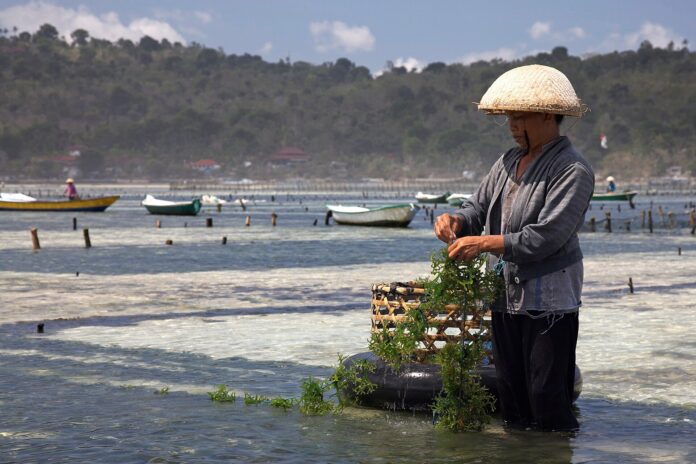
File photo: seaweed farming in Indonesia (not in Bangladesh). Photo: Jean-Marie Hullot on flickr and Jmhullot on commons; Papa Lima Whiskey Original upload and image description written by User:Snowmanradio. / CC BY-SA 2.0, via Wikimedia Commons
This article was prepared by Maritime News BD from the report(s) and documents listed above; it was not independently reported by Maritime News BD.