

The world’s shipyards now have more work on their books than at any time in history. The global orderbook reached 226.1 million compensated gross tonnes (cgt) in October, narrowly passing the previous high of 225.5m cgt set in September 2008, according to Clarksons Research figures reported by Splash247.
The backlog is valued at roughly $700 billion. It has grown 24% in a year and is three times its 2020 size.
A record output wave is coming
- 2027: about 64m cgt of deliveries forecast, 18% above the 2010 record of 55m cgt.
- 2028: output could reach 72m cgt, around 60% higher than in 2025.
Not a repeat of 2008
The comparison with the last boom has limits. Today’s orderbook equals about 25% of the existing fleet by gross tonnage, against 53% in 2008. The mix has also changed:
- Containerships make up 31% of the orderbook by cgt, nearly double their 2008 share.
- Gas carriers have risen from 5% to 15%, while bulkers have dropped from 31% to 17%.
- 43% of ships on order can run on alternative fuels, compared with 2% at the last peak.
China’s grip
Chinese yards hold 68% of the global orderbook, double their 2008 share, and will deliver about 60% of this year’s output. South Korea’s share has slipped to 17% and Japan’s to about 8%. Six of the ten biggest yards by orderbook are Chinese, led by Dalian-based Hengli, which restarted shipbuilding only in 2022 and now has 485 ships on order.
Some in the industry are uneasy. BIMCO has warned that the capacity build-out could leave yards idle once ordering cools, and several shipowners have warned of oversupply in the years ahead.
Based on reporting by Splash247, 2 November 2026, citing Clarksons Research.
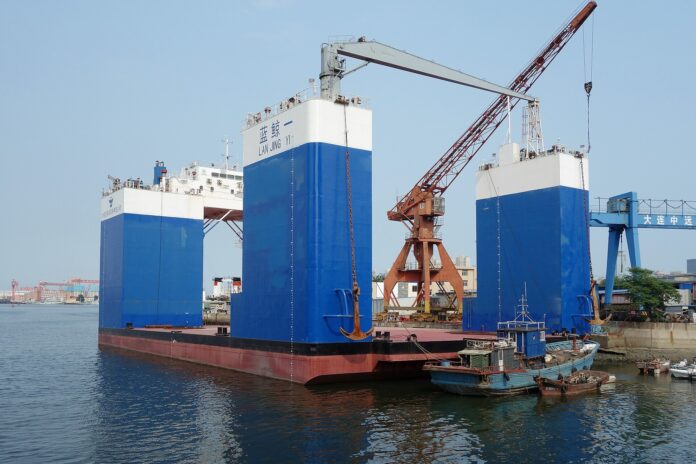
Photo: Representative image: a ship at Dalian Shipyard, China (2019). Tyg728 / Wikimedia Commons, CC BY-SA 4.0