

Maritime News BD In Depth. Reported facts are attributed to the sources listed at the end. Sections marked as analysis are the views of Maritime News BD.
For years the beaches of Sitakunda, north of Chattogram, were where much of the world’s merchant fleet came to die. Ship recycling supplies a large share of Bangladesh’s steel scrap, supports tens of thousands of jobs directly and indirectly, and has long been one of the country’s most dangerous workplaces. In the past two years three things have changed the outlook: Bangladesh has lost its position as the world’s largest shipbreaking nation, an international convention on safe ship recycling has entered into force, and a single accident in August 2026 killed ten people at a yard that had been certified as compliant.
Background: from world leader to second place
According to The Financial Express, Bangladesh imported 88 end-of-life ships with a combined weight of about 2.68 million tonnes for scrapping in 2025, down from 130 ships in 2024. India dismantled 111 ships (about 3.36 million tonnes) in the same year, taking the top spot. The figures come from the NGO Shipbreaking Platform, which counted 321 ocean-going vessels scrapped worldwide in 2025, of which 214 large ships were broken on the beaches of Bangladesh, India and Pakistan, accounting for more than 85% of global tonnage.
Bangladesh’s volumes have fallen steadily from a peak of 254 ships in 2021, to 122 in 2022, 170 in 2023, 130 in 2024 and 88 in 2025, according to the same report. Reasons cited include stricter international standards, which bar non-compliant yards from importing ships; the dollar crisis and high interest rates; and funding shortages that prevent yards from completing green certification. The NGO Shipbreaking Platform also noted that overall scrapping is low because freight rates have been favourable, hiding a growing backlog of ageing ships.
The Bangladesh Ship Breakers and Recyclers Association (BSBRA) told FE that 23 yards are compliant, 17 fully certified under the Hong Kong Convention and six provisionally certified, with around 20 more seeking certification at a cost of between Tk 30 crore and Tk 100 crore (Tk 300 million to Tk 1 billion) per yard. Industry representatives also asked the government to reclassify shipbreaking from the “red” to the “orange” environmental category, because, they say, banks avoid financing yard upgrades for a sector classified as “red”. Certification approvals can take months, during which owners pay interest on loans.
Safety remains the central concern. The NGO Shipbreaking Platform recorded at least 11 deaths and 62 injuries in South Asian shipbreaking in 2025, FE reported, including an oil-tank explosion at a Chattogram yard that injured eight workers dismantling a government-owned vessel.
The Hong Kong Convention: what changed in June 2025
The IMO’s Hong Kong International Convention for the Safe and Environmentally Sound Recycling of Ships entered into force in June 2025. Bangladesh acceded in 2023. The convention requires recycling facilities to have an approved Ship Recycling Facility Plan, and ships to carry an Inventory of Hazardous Materials. It sets rules for gas-free certification, hazardous waste handling and worker protection.
In practice, “green” or compliant yards in Bangladesh have built impermeable floors, cranes, drainage systems and training centres, and work with international classification societies. Critics, including the NGO Shipbreaking Platform, argue that beaching itself, where ships are run onto tidal mudflats and cut up, cannot be made fully safe or environmentally sound, whatever the paperwork says.
The Ferdous Steel accident: a test of the system
On 14 August 2026, workers at Ferdous Steel Ship Recycling Industry in Sitakunda were breaching a ballast tank on the scrap tanker MT Rasi when toxic hydrogen sulphide gas was released. Nine people died at the scene and one later in hospital, according to The Financial Express. Maritime Executive reported that the yard was certified under the Hong Kong Convention.
An 11-member investigation panel formed by the Ministry of Industries found severe safety lapses, FE reported on 31 August. Workers had no gas masks or self-contained breathing apparatus; the work took place on a weekly holiday; and there was no safety manager, ambulance, doctor or emergency rescue team on site. The panel recommended disciplinary action against the yard owner under the Ship Breaking and Recycling Rules 2011, and the industries minister said anyone found negligent would face legal action.
By coincidence, the accident came one day after government meetings on 13 August on making the shipbuilding and ship recycling industries safe and sustainable, reported by The Business Standard and UNB. Those meetings discussed reviewing laws and the need for a proper treatment, storage and disposal facility (TSDF) for hazardous waste from the yards.
Editorial analysis: certification is not the same as safety
The following is Maritime News BD’s analysis, based on the reporting above.
1. Paper compliance versus daily practice. The Ferdous Steel case shows that a certificate describes systems that exist on paper and in audits. It does not guarantee that they are used on a holiday, on a night shift, or when a supervisor is under pressure to finish a job. Regular unannounced inspections, with published results, would help close that gap.
2. Gas-free procedures are the critical point. Hydrogen sulphide in ballast and cargo tanks is a known hazard in tanker recycling. Gas testing before entry, continuous monitoring, breathing apparatus and a standby rescue team are standard requirements. The panel’s findings suggest those basic controls failed. Every yard handling tankers should be able to show regulators its gas-free certificates and confined-space entry permits.
3. Hazardous waste needs somewhere to go. Asbestos, oily sludge, PCBs and heavy metals removed from ships must be treated and disposed of safely. Without a national TSDF, even well-run yards struggle to show where their hazardous waste ends up. Building one is a public responsibility, not only a cost for yard owners.
4. Falling volumes cut both ways. Fewer ships mean less income for compliant yards that borrowed heavily to upgrade. If the industry contracts too far, the yards that invested in safety may be the ones that cannot service their debts. Policy should reward compliant yards, for example with easier access to letters of credit, rather than treating all yards alike.
Opportunities
- A coming wave of scrapping: many ships built during the 2000s shipbuilding boom are reaching the end of their lives, and decarbonisation rules may accelerate retirements. Certified yards are best placed to win this business.
- Premium for compliance: European and Japanese shipowners increasingly want to sell only to certified yards, which can support better prices for compliant Bangladeshi facilities.
- Domestic steel supply: recycled steel reduces the need for imported raw materials and energy-intensive primary steelmaking.
- Skills and jobs: modernised yards need trained crane operators, safety officers, hazardous materials specialists and engineers.
Risks
- Repeat accidents that damage Bangladesh’s reputation with shipowners and regulators.
- Financial stress on yards that invested in compliance while volumes fell.
- Environmental damage to the Sitakunda coast if hazardous waste is not properly managed.
- Weakening standards if reclassification or other relaxations are not matched by stronger enforcement.
What needs to happen next
Analysis: Three steps would make the biggest difference. First, publish the full findings of the Ferdous Steel investigation and act on them, so that certification carries real consequences. Second, build the national hazardous waste facility discussed in August. Third, link financial support, such as letter-of-credit facilities, to verified safety performance, so that the yards that protect their workers are the ones that grow.
Bangladesh can remain a leading ship recycling nation under the Hong Kong Convention. But the industry’s future will depend less on the number of certificates on the wall than on whether every worker who enters a tank goes home at the end of the day.
Figures are as reported by the cited sources. Maritime News BD has not independently verified industry or government data.
Sources
- The Financial Express: “Bangladesh loses top spot in global shipbreaking as imports of scrapped vessels drop 32pc” (25 Feb 2026)
- The Financial Express: “Probe recommends action against Sitakunda shipyard owner over 10 worker deaths” (31 Aug 2026)
- Maritime Executive: “Nine killed in toxic gas accident at HKC-certified shipbreaking yard” (Aug 2026)
- The Business Standard / UNB: “Initiative taken to make shipbuilding, recycling industries safe” (14 Aug 2026)
- The Financial Express: “Experts investigate whether decomposing matter produced deadly gas in Ferdous Steel” (Aug 2026)
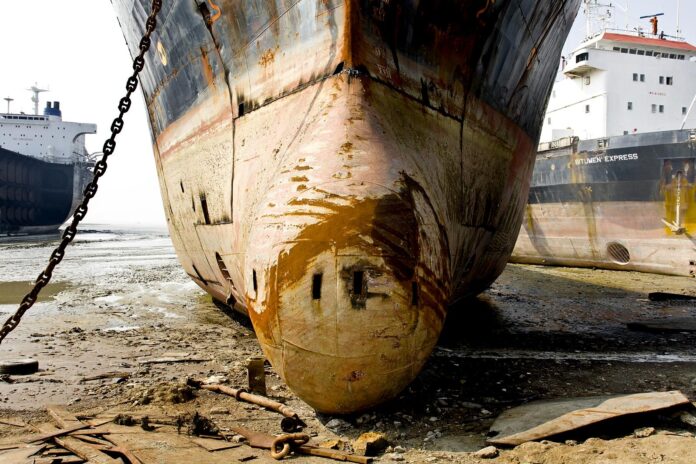
File photo: The bow of a beached ship awaiting dismantling at a ship recycling yard in Chattogram. Photo: Naquib Hossain from Montreal, Philadelphia, Dhaka / CC BY-SA 2.0, via Wikimedia Commons
This article was prepared by Maritime News BD from the report(s) and documents listed above; it was not independently reported by Maritime News BD.